


Dado à appears in Portuguese descriptions of interests, habits, or tendencies. In a sentence such as Ele é dado à música, it suggests that someone has a strong inclination toward music. The precise English translation depends on the rest of the sentence.
English speakers may find the phrase confusing because dado can also mean “given,” while the accented à follows a particular Portuguese grammar rule. Neither word should be translated without considering its role in the sentence.
This guide explains both meanings, the grave accent, adjective agreement, and differences between dado a, dado à, and dado ao. Examples and exercises show how to use each form.
What Does Dado à Mean in Portuguese?
When dado describes a person’s disposition, ser dado a means “to be inclined toward,” “to be fond of,” or “to be given to” something. It usually describes a continuing interest or recognizable tendency rather than a single event.
For example, Ele é dado à música can mean “He is fond of music” or “He has a natural inclination toward music.” The word música completes the thought. By itself, dado à leaves the reader asking: inclined toward what?
The construction comes from dado, the past participle of dar, the Portuguese verb “to give.” However, the descriptive meaning is not necessarily about handing something to someone. It functions like an adjective, much as English uses “given to” in “given to daydreaming.”
Portuguese also uses dado for a die used in games and dados for data. Those are different meanings of the same written form, not translations of this expression.
Two Different Uses: Inclination and an Actual Gift
The same written sequence can appear in sentences with different grammatical structures.
Describing Someone’s Inclination
In O rapaz é dado à leitura (“The boy is fond of reading”), dado describes a characteristic. The verb é (“is”) connects the person with that characteristic, and à leitura identifies the activity.
The expression does not prove that the person reads every day or is especially talented. It simply presents reading as something toward which the person is inclined.
Describing Something That Was Given
In O livro foi dado à professora (“The book was given to the teacher”), dado is part of a passive verb construction. The book is what was given, and the teacher is the recipient.
Here à can be translated as “to the.” The sentence describes an action, not someone’s personal habits. The surrounding verbs and nouns determine the meaning.
Mast Read: Babybelletje Cheese: What’s Inside the Small Wax-Coated Snack?
Why Is There a Grave Accent in à?
The accent in à marks a contraction called crase. In the usual pattern, Portuguese combines the preposition a (“to” or “toward”) with the feminine definite article a (“the”). Written separately, the two elements would be a + a; combined, they become à.
The expression ser dado a requires the preposition a. In dado à música, the following noun música is used with the feminine article a. This produces the accented form. In the plural, a + as becomes às.
Crucially, à does not mean that the person being described is female. The feminine article belongs to the following noun, not the person. A man can be dado à música, and a woman can be dada ao esporte.
The mark is called a grave accent. Its job here is to show the contraction, not to place word stress on à. It is also not automatically added before every feminine word; the article must actually be present in the construction.
Dado a, Dado à, and Dado ao: How They Differ
All three forms can be correct. The choice depends primarily on whether the preposition is followed by an article, and if so, which article.
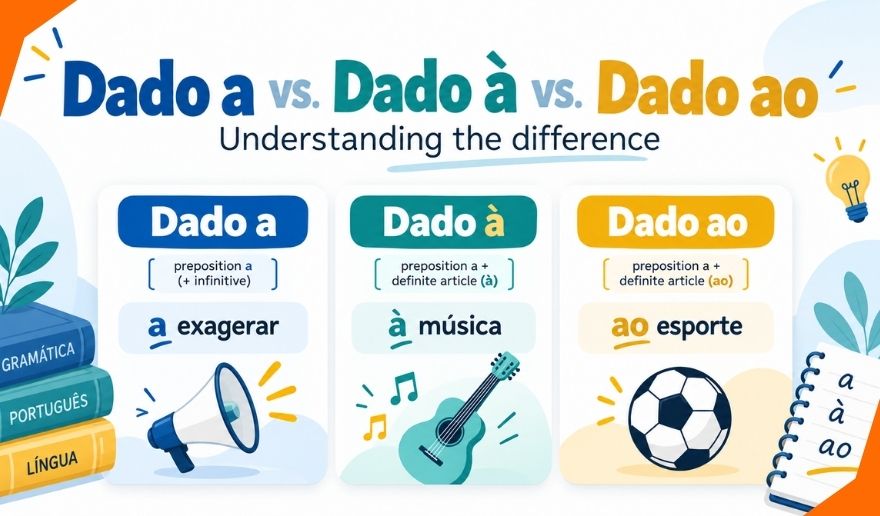
Dado a: Preposition Without an Article
Use a by itself before an infinitive verb: Ele é dado a exagerar (“He tends to exaggerate”). There is no feminine article before exagerar, so the grave accent would be incorrect.
A bare noun can also follow the preposition in suitable contexts. For instance, Ele é dado a discussões describes someone inclined to arguments or discussions in general. The presence of a feminine noun alone does not force à.
Dado à: Preposition Plus Feminine Article
Use à when the following expression contains the singular feminine article: Ela é dada à poesia (“She is fond of poetry”) or Ele é dado à leitura (“He enjoys reading”).
Dado ao: Preposition Plus Masculine Article
Use ao when a combines with masculine o: Ela é dada ao esporte (“She is fond of sports”). Plural combinations are aos for masculine and às for feminine: dado aos jogos and dado às artes, where appropriate in context.
Gender and Number Agreement With Dado
As a descriptive adjective, dado agrees with the person or group it describes. Its forms are dado (masculine singular), dada (feminine singular), dados (masculine or mixed plural), and dadas (feminine plural).
Compare these sentences:
- O aluno é dado à leitura. — The male student is fond of reading.
- A aluna é dada à leitura. — The female student is fond of reading.
- Os alunos são dados à leitura. — The students are fond of reading.
- As alunas são dadas à leitura. — The female students are fond of reading.
Notice that à leitura stays unchanged. The noun leitura is still feminine singular even as the subject changes. If the following noun changes instead, the contraction may change without the adjective changing: Ele é dado à música but Ele é dado ao esporte.
Passive sentences also show agreement. O livro foi dado à professora becomes A carta foi dada à professora when the thing given is feminine. Agreement follows the grammatical subject, not the recipient.
Examples of Dado à in Everyday Portuguese
The easiest way to learn the expression is to compare full sentences. English translations below favor natural meaning rather than a word-for-word match.
Interests, Hobbies, and Creative Activities
Ele é dado à música. — He has a strong interest in music.
Ela é dada à leitura. — She enjoys reading and is naturally drawn to books.
O artista é dado à experimentação. — The artist is inclined to experiment.
These describe interests, not necessarily professional training or skill.
Habits, Behavior, and Social Interaction
Ele é dado à conversa. — He likes to talk or is naturally talkative.
Ela não é dada à conversa fiada. — She is not inclined toward idle chatter.
Ele é dado à bebida. — He is given to drinking, often with a negative implication.
The expression itself is not positive or negative. Música suggests an interest; bebida may suggest an unhealthy habit depending on context. The surrounding words establish the speaker’s attitude. Negative sentences are particularly useful because não é dado à… can mean someone does not usually engage in an activity.
Choosing the Right English Translation
“Given to” is a close English pattern, but it can sound formal or old-fashioned. The Portuguese construction can also sound more descriptive than gostar de (“to like”). Often, everyday English offers a clearer way to express what the Portuguese speaker means.
Use “fond of” or “interested in” for a preference: dado à música may mean “fond of music.” Use “inclined toward” when discussing an enduring tendency: dado à reflexão could mean “inclined toward reflection.” Use “prone to” for a habit or behavior, especially one viewed negatively: dado à bebida may be rendered “prone to drinking.”
The context also affects how strong the translation should be. “Fond of reading” does not necessarily mean “devoted to reading.” Similarly, “tends to argue” is less absolute than “always argues.” Choose English wording that preserves the original degree of certainty.
In passive sentences, translate the action instead. A carta foi dada à professora means “The letter was given to the teacher,” not “The letter was fond of the teacher.”
How to Write Your Own Sentences Correctly
Build a descriptive sentence by choosing the subject, matching dado to it, and checking what follows the preposition.
- Choose a subject: Ele (he), Ela (she), or a plural noun phrase.
- Select the adjective: dado, dada, dados, or dadas.
- Add the activity or tendency: for example, a leitura, o esporte, or exagerar.
- Check the preposition: write à leitura, ao esporte, or a exagerar.
For example, start with Ela, choose dada, and add a leitura: Ela é dada à leitura. To make it negative, place não before the verb: Ela não é dada à leitura (“She is not particularly inclined to reading”).
A helpful check for à is to try a comparable masculine noun. If the corresponding construction uses ao, the feminine version will normally use à. This is a check on the article, not a requirement to change the subject’s gender.
Try these corrections: Ele é dado à exagerar; Ela é dado à leitura; Ele é dado a música (with a música intended); and O livro foi dada à professora. The corrected forms are a exagerar, Ela é dada à leitura, Ele é dado à música, and O livro foi dado à professora.
Similar Portuguese Expressions That Mean Something Else
Dada a: Given or Considering
Dada a situação, mudamos os planos means “Given the situation, we changed our plans.” Here dada agrees with situação, and the following a is just the definite article, not a contraction. Writing Dada à situação for this meaning is incorrect.
The same pattern appears with masculine and plural nouns: Dado o problema (“Given the problem”) and Dadas as circunstâncias (“Given the circumstances”). There is no preposition a between dado and those articles.
Dado que: Given That or Since
Dado que estava chovendo, ficamos em casa means “Since it was raining, we stayed home.” This connects a reason with a result. It is not a description of someone who enjoys or tends toward an activity.
Devido à: Due To
O evento foi adiado devido à chuva means “The event was postponed due to the rain.” In devido à, the preposition combines with the feminine article, but devido a is a different construction from both ser dado a and dada a.
Common Mistakes and How to Fix Them
Adding an Accent Before a Verb
Write dado a exagerar, not dado à exagerar. An infinitive does not take a feminine definite article here, so there is no contraction to mark. The same applies to dado a viajar (“inclined to travel”).
Making the Adjective Match the Following Noun
In Ele é dado à leitura, dado stays masculine because ele is masculine. The feminine noun leitura affects à, not the ending of dado. Conversely, Ela é dada ao esporte correctly combines a feminine adjective and a masculine contraction.
Assuming Every Feminine Noun Needs à
A contraction is required only if the preposition and feminine article occur together. When the expression uses a noun without an article, a can remain unaccented. Check the entire construction rather than the noun’s gender in isolation.
Confusing a Cause With an Inclination
Dada a dificuldade, cancelamos a reunião means “Given the difficulty, we canceled the meeting.” It is not an example of ser dado à. A useful clue is that causal dada a often introduces the circumstances behind a decision.
Simpler Alternatives for Everyday Portuguese
Simpler expressions can sometimes communicate preferences or habits more directly.
Gostar de: To Like
Ela gosta de música means “She likes music.” This is a simple choice for expressing enjoyment without suggesting that the interest is a defining tendency.
Ter tendência a: To Tend To
Ele tem tendência a exagerar means “He tends to exaggerate.” Use it when the main point is a recurring behavior, especially if you want a straightforward statement rather than a character description.
Ser propenso a: To Be Prone To
Ele é propenso a exagerar means “He is prone to exaggerating.” This works when describing predisposition and may sound more analytical. It does not always imply the same sense of personal enjoyment found in ser dado à música.
Choose the expression that matches the intended meaning. Words for liking, habitual behavior, and predisposition overlap, but they are not automatically interchangeable.
Final Thoughts
Dado à is not a complete expression with a single fixed English translation. It can form part of a description of someone’s interests or habits, or appear in a passive sentence about something being given. The surrounding sentence determines which meaning applies.
For accurate writing, check two things separately: whether dado agrees with the subject and whether the following phrase requires a, à, or ao. Practicing complete sentences is a more reliable approach than memorizing one translation.
FAQs
What Does Dado à Mean in English?
In descriptions of a person, it can mean “fond of,” “inclined toward,” or “given to.” In a passive sentence such as O livro foi dado à professora, it contributes to “was given to the teacher.” Context decides.
Is Dado à a Complete Expression in Portuguese?
Usually not. When describing a tendency, it typically needs a complement, such as música or leitura. In a sentence, other words also show who has the tendency and whether dado is descriptive or part of a passive verb.
Why Does Dado à Have a Grave Accent?
The accent signals crase, usually the joining of preposition a and feminine article a. In dado à música, the article belongs to música. The accent does not tell you whether the person being described is male or female.
What Is the Difference Between Dado a and Dado à?
Dado a contains an uncontracted preposition, as in dado a exagerar. Dado à includes the preposition plus feminine article, as in dado à leitura. Both may be correct; the following words determine which to write.
Can Dado à Describe a Man or a Woman?
Yes. Ele é dado à leitura describes a man, and Ela é dada à leitura describes a woman. The adjective changes to agree with the subject, while the contracted à remains because leitura is feminine.
Can Dado à Refer to Negative Habits?
Yes. Ser dado à bebida may suggest habitual drinking and carry a negative judgment. Other complements, such as music or reading, can sound positive. The expression itself describes an inclination; its tone comes from the context.
Is Dado à the Same as Dada a or Dado que?
No. Dada a situação means “given the situation,” and dado que usually means “given that” or “since.” Neither construction expresses the same descriptive meaning as ser dado à leitura. Their grammar also differs.
How Can Beginners Remember When to Use Dado à?
First match dado with the subject. Then check whether the following phrase contains the feminine article a. If the preposition and article combine, write à. If an infinitive follows, normally use plain a instead.
For More News and Daily Updates Visit: Gigly Magazine
