

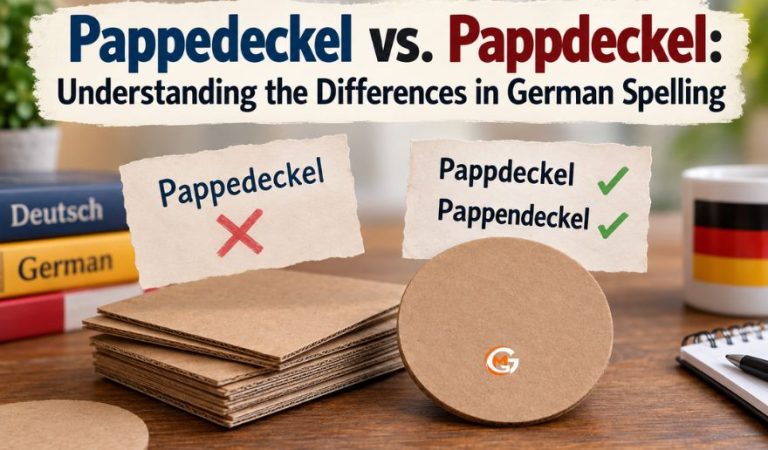
Pappedeckel is a spelling that readers may encounter while looking for the German word for a piece of cardboard or a cardboard object. The important distinction is that German dictionaries recognize Pappdeckel and Pappendeckel, rather than treating all three spellings as interchangeable standard forms.
That difference matters when translating a label, writing in German, preparing schoolwork, or identifying an unfamiliar item. A letter or two can change whether a word looks natural to a German reader, even when its intended meaning is clear.
This guide explains the accepted spellings, their meanings and pronunciation, and the grammar behind them. It also provides everyday examples, regional context, and practical advice for choosing an accurate English translation.
What Does Pappedeckel Mean?
The spelling Pappedeckel is usually intended to refer to something made of Pappe, the German word for cardboard or stiff paperboard. However, the established dictionary terms for the basic concept are Pappdeckel and Pappendeckel. Both can mean a piece of cardboard, often a flat, relatively stiff piece.
The word does not have to refer to a particular branded item or even to a lid. Someone might be talking about a cardboard piece used for support, a cover, or an object placed beneath a drinking glass. The surrounding sentence tells you which interpretation makes sense.
For a reader who has only the isolated word, “piece of cardboard” is a reasonable starting translation. More specific choices, such as “cardboard lid” or “coaster,” need evidence from the context.
Is Pappedeckel a Correct German Spelling?
Pappedeckel: Not an Established Standard Form
Pappedeckel appears in online writing, but it is not the form recorded in the standard dictionary entries for this meaning. It may result from confusing two similar recognized spellings. An appearance on a website, by itself, does not establish a word as standard German.
That does not mean every person who writes it is impossible to understand. It means writers should avoid presenting this spelling as a normal alternative without credible linguistic evidence.
Pappdeckel: A Recognized Form
Der Pappdeckel is an established masculine noun. Its basic dictionary definition is a piece of cardboard, sometimes described as rectangular. A German example about serving a drink on one shows that the word is not restricted to the lid of a box.
Pappendeckel: Also Recognized
Der Pappendeckel is another accepted form with essentially the same core meaning. Dictionaries explicitly connect it with Pappdeckel. The extra letters make the word longer; they do not automatically point to another material, product, or manufacturing method.
Pappdeckel vs. Pappendeckel: What Actually Changes?
The Written Forms
The short form is Pappdeckel; the longer one is Pappendeckel. The longer form contains an additional -en- sequence between the beginning of the word and Deckel. Pappedeckel instead inserts an e without the n found in Pappendeckel.
These are spelling distinctions, not three formally defined types of cardboard. In particular, it would be misleading to say that one word means a reusable lid and the other means disposable packaging.
Their Shared Meaning
Both recognized forms can identify a flat piece of stiff cardboard. Depending on context, that piece may function as backing, a cover, or a coaster. The words alone do not reliably tell you its dimensions, thickness, finish, or intended lifespan.
For ordinary writing, consistency is more valuable than switching between the forms. Choose a recognized form appropriate to your audience and use it throughout the same text.
How German Word Formation Explains the Difference
German creates many compound nouns by combining familiar words. Here, Pappe means cardboard or stiff paperboard, while Deckel usually means a lid or cover. Knowing these components helps an English speaker remember the word, but it does not supply a complete definition.
Compound nouns can develop conventional spellings that do not mirror a simple word-for-word combination. Pappdeckel has the shorter structure, and Pappendeckel has the additional -en- sequence. Both have become established vocabulary forms.
It is important not to turn this example into a universal spelling rule. Some German compounds contain connecting sounds or letters, while others do not. The correct form of a particular compound is something to check, rather than construct mechanically.
German nouns are also capitalized. In regular German prose, write Pappdeckel or Pappendeckel with an initial capital letter, even in the middle of a sentence.
What Can Pappdeckel Refer to in Everyday Life?
The central meaning is a piece of cardboard, but cardboard appears in many shapes and settings. In a craft project, it might be a rigid piece placed under paper or used to strengthen a display. In packaging, it could be a removable cover or a flat backing piece.
In a café or restaurant, a Pappdeckel may be placed under a glass. This use is supported by German dictionary examples, although the more specific word Bierdeckel is generally preferable when the object is a beer mat or drink coaster.
Material descriptions need extra care. A word referring to cardboard does not establish that the object is recyclable in every location, food-safe, waterproof, or suitable for repeated use. Those properties depend on its composition and any coatings, adhesives, or other treatments, not on its German name.
Mast Read: startupbootedmagfusehub com Guide: Understanding Its Purpose and Possible Uses
How to Pronounce Pappdeckel and Pappendeckel
In Pappdeckel, the main stress falls on the first part, Papp. A rough English-speaking guide is “PAPP-deh-kel,” with a short vowel in the first syllable. The word is divided for German hyphenation as Papp-de-ckel.
Pappendeckel also stresses the beginning, but it has an additional sound between Papp and Deckel. A helpful approximation is “PAPP-en-deh-kel”; German speech may make the middle vowel much less noticeable than this spelling suggests.
These English approximations are guides, not exact phonetic transcriptions. For careful pronunciation, listen to a reliable German dictionary recording and repeat the word at normal conversational speed. The two accepted forms should not be treated as identical in sound.
German Grammar: Articles, Cases, and Plurals
Both words are masculine nouns: der Pappdeckel and der Pappendeckel. In the nominative singular, der is the definite article, equivalent to “the.” This matters because German articles and adjective endings change according to grammatical case.
The accusative singular uses den Pappdeckel, while the dative singular uses dem Pappdeckel. The genitive is des Pappdeckels. The longer form follows the same pattern: den Pappendeckel, dem Pappendeckel, and des Pappendeckels.
The plural forms are die Pappdeckel and die Pappendeckel. Neither gains an extra ending in the nominative plural. In the dative plural, however, the forms become den Pappdeckeln and den Pappendeckeln.
For example, Ich brauche einen Pappdeckel means “I need a piece of cardboard.” In Ich arbeite mit den Pappdeckeln, the plural ending appears because mit requires the dative case. The same rules apply when using Pappendeckel.
Are There Regional Differences in German-Speaking Countries?
German is spoken across several countries, including Germany, Austria, and Switzerland, and everyday word choices are not identical everywhere. Pappendeckel is documented in Austrian vocabulary resources, where it may refer to cardboard or a cardboard carton. It is therefore particularly useful to recognize when reading Austrian German.
However, regional association does not mean that Pappdeckel is forbidden in Austria or that Pappendeckel is never used elsewhere. Dictionaries record both, and individual speakers may prefer one form based on local habits, family usage, or context.
Claims about Pappedeckel require more caution. Its online appearance is not enough to prove that it is an established Austrian or southern German variant. In formal writing, use a documented spelling unless you are intentionally reproducing someone’s actual words.
Choosing the Right English Translation
Cardboard, Paperboard, and Pasteboard
If the speaker means the material, cardboard is usually the most natural general English word. If a single item is meant, “piece of cardboard” or “cardboard sheet” may read better. Paperboard is useful in technical discussions, while pasteboard is an older or more specialized word, particularly in some bookbinding contexts.
Do not assume these English terms are completely identical in every industry. Packaging specifications may distinguish materials by structure or intended application. When precision matters, translate the physical description rather than relying on a broad dictionary equivalent.
Lids, Covers, and Coasters
“Cardboard lid” works when the object actually closes a container, and “cardboard cover” fits when it protects or covers something. If it sits under a drink, “coaster” describes its purpose more clearly than “lid.” In British English, “beer mat” may be especially natural for a coaster used with beer.
The basic test is simple: identify what the object does before choosing the English noun. A literal reading of Deckel as “lid” can be helpful, but it is not always the best translation of the complete compound.
Practical German Sentences With English Meanings
Short sentences show why the same German noun can receive different English translations. The following are illustrative examples written to demonstrate ordinary grammatical usage, not quotations from a particular source.
Ich brauche einen Pappdeckel für mein Bastelprojekt.
“I need a piece of cardboard for my craft project.” Here, einen signals the masculine accusative, and “piece of cardboard” is more natural than “lid.”
Sie legt einen Pappdeckel unter das Glas.
“She puts a cardboard coaster under the glass.” The action identifies the object’s role. Translating it as a lid would create the wrong picture.
Der Pappdeckel auf der Schachtel ist beschädigt.
“The cardboard lid on the box is damaged.” This time the box supplies the missing context, so “lid” is appropriate.
Wir schneiden zwei Pappendeckel aus.
“We cut out two pieces of cardboard.” The longer recognized form appears here, but the material remains the same. The plural is unchanged after zwei.
Mit den Pappendeckeln kann man die Rückseite verstärken.
“You can reinforce the back with the cardboard pieces.” This example illustrates the dative plural ending and describes a practical use.
Taken together, these examples show why the spelling question and the translation question should be handled separately. First confirm which German form is being used; then use the full sentence to decide what the speaker means.
Common Spelling and Translation Mistakes
Treating Every Online Spelling as Standard
A website may contain Pappedeckel without explaining where its spelling comes from. Copying it into a German assignment or a product description can spread an unverified form. Consult an established dictionary and use Pappdeckel or Pappendeckel unless a specific source justifies a different spelling.
Assuming the Two Accepted Forms Name Different Products
Pappdeckel and Pappendeckel have the same general dictionary meaning. Neither automatically specifies a particular cardboard grade, shape, or coating. A buyer or translator who needs technical precision should look for measurements, material specifications, and the actual function of the object.
Translating Every Occurrence as “Cardboard Lid”
The individual word Deckel commonly means “lid,” but the compound can simply mean a piece of cardboard. A literal translation may sound awkward or inaccurate when the object is flat backing or a coaster. Start with context, then choose the narrowest justified English expression.
How to Check the Spelling and Related German Words
When preparing a translation, start with a reputable German dictionary and check the full entry, not just a suggested spelling. Confirm the article, plural, definition, and any regional labels. A second dictionary can help when the text comes from a specific German-speaking country.
If the object is not just a generic cardboard piece, another term may communicate more clearly. Pappe refers to the material; Karton may mean cardboard, paperboard, a carton, or a box according to context. These are related words, not guaranteed substitutes in every sentence.
Bierdeckel for a Drink Coaster
Bierdeckel is the specific German word for a beer mat or coaster. It is a better choice when describing that recognizable item, although a Pappdeckel can also be placed under a drink. The distinction is between a broad material-related expression and a more specific object name.
Deckel and Other Cover Terms
Deckel alone means a lid or cover; Kastendeckel and Schachteldeckel can identify the lid of a box or case in suitable contexts. When editing a description, choose the term that names the object accurately rather than forcing a cardboard-related compound into every situation.
Final Thoughts
The central spelling distinction is straightforward: Pappdeckel and Pappendeckel are recognized German nouns, while Pappedeckel is not established as a standard alternative in the dictionaries consulted. The accepted forms share a basic meaning connected to a piece of cardboard.
For English translation, the physical context matters as much as spelling. A cardboard piece, a box lid, and a drink coaster are not interchangeable descriptions, even if one German word could appear in examples involving each.
When writing for a German-speaking audience, use a documented form consistently. When translating, confirm what the object actually is before choosing the most natural English wording.
FAQs
1. Is Pappedeckel a recognized word in standard German?
It is not listed as a standard form in the main dictionary entries for this meaning. Pappdeckel and Pappendeckel are documented alternatives. If you need a reliable spelling for school or professional writing, choose one of those.
2. What is the difference between Pappedeckel and Pappdeckel?
Pappdeckel is an established German noun meaning a piece of cardboard. Pappedeckel is a different spelling that appears online but lacks the same dictionary recognition. Their likely intended meaning may overlap, but their spelling status differs.
3. Are Pappdeckel and Pappendeckel both correct German spellings?
Yes. Both are documented in German dictionaries and have essentially the same core meaning. The second contains an additional -en- sequence. Neither form, by itself, specifies a separate type of cardboard or lid.
4. What does Pappdeckel mean in English?
“Piece of cardboard” is a dependable general translation. Depending on the sentence, “cardboard,” “cardboard lid,” or “coaster” may sound more natural. The right choice depends on the item being described, not just its individual word parts.
5. Does Pappdeckel always mean a cardboard lid?
No. Although Deckel commonly means “lid,” the compound Pappdeckel has a broader dictionary meaning. It may describe a cardboard piece used for another purpose, including placing it beneath a drinking glass.
6. Is Pappendeckel commonly used in Austria?
Pappendeckel is recorded in Austrian vocabulary resources, so readers of Austrian German may encounter it. That supports a regional association, but it does not establish exact frequency or mean the word is exclusive to Austria.
7. What is the correct plural form of Pappdeckel?
The nominative plural is die Pappdeckel, with no extra ending. In the dative plural, the form is den Pappdeckeln. The longer word behaves similarly: die Pappendeckel and den Pappendeckeln.
8. Is Pappdeckel the same as Bierdeckel?
Not exactly. Bierdeckel specifically refers to a beer mat or coaster, while Pappdeckel has the broader meaning of a piece of cardboard. A cardboard coaster may fit both descriptions, but not every Pappdeckel is a Bierdeckel.
For More News and Daily Updates Visit: Gigly Magazine
