

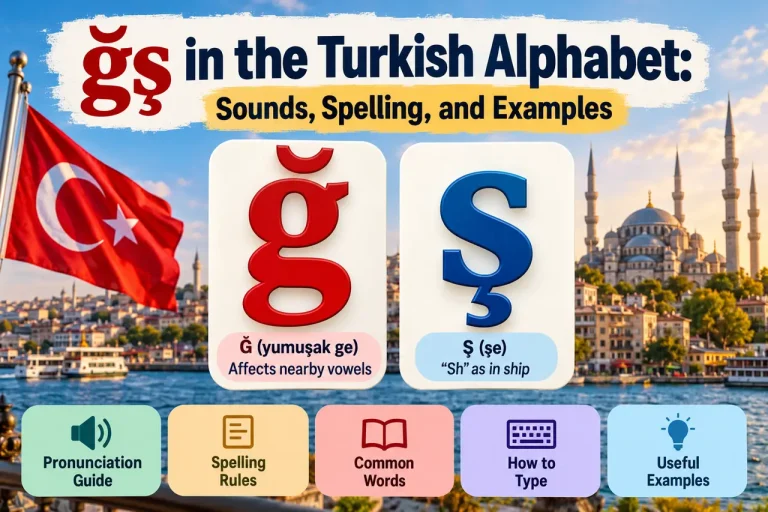
Turkish uses a familiar-looking Latin alphabet, but some letters do not work the way English speakers expect. Two that often cause confusion are ğ and ş. Those marks matter.
If you have seen ğş together in a search or message, you may wonder whether it is a word, a special sound, or an alphabet character. In standard Turkish, these are two separate letters, not a single combined letter.
Knowing them helps you read names, pronounce words, and type Turkish correctly. Here are the sounds, examples, and practical tips.
Quick Bio: Turkish Letter Facts
| Detail | Information |
|---|---|
| Language | Turkish |
| Writing system | Latin-based alphabet |
| Modern alphabet adopted | 1928 |
| Number of letters | 29 |
| Characters discussed | Ğ/ğ and Ş/ş |
| One combined letter? | No |
| Name of Ğ | Yumuşak ge (soft g) |
| Position of Ğ | 9th letter |
| Mark above Ğ | Breve |
| Main role of Ğ | Affects nearby vowels |
| Name of Ş | Şe |
| Position of Ş | 23rd letter |
| Sound of Ş | “Sh” as in ship |
| Mark below Ş | Cedilla |
What Does ğş Mean in Turkish?
The sequence ğş does not have an established meaning as an ordinary standalone Turkish word. It usually points to two characters that people want to identify or type. Ğ is called yumuşak ge (“soft g”), while ş is şe and represents a consonant. You may see both letters within the same word, but that does not make them one alphabet symbol. Understanding them separately makes Turkish easier to read. When you see these characters online, check the surrounding text before assuming they name a person, product, or concept. A pair of letters is not automatically a meaningful word.
Where Ğ and Ş Fit in the Turkish Alphabet
Modern Turkish has 29 letters. The Latin-based alphabet was adopted in 1928. Ğ follows G as the ninth letter, while Ş follows S as the twenty-third. They are full letters in their own right. The curved mark above ğ is a breve; the hook beneath ş is a cedilla. Other distinct Turkish letters include ç, ı, ö, and ü. Turkish spelling often reflects pronunciation, although ğ is unusual. Dictionaries alphabetize ş after s rather than ignoring its mark.
How to Pronounce Ğ (Soft G)
At the End of a Word or Before a Consonant
In standard Istanbul Turkish, ğ is not spoken like the hard g in go. It often lengthens the previous vowel. For example, dağ means “mountain” and is commonly pronounced with a longer a sound, rather than a final g. Yağ (“oil” or “fat”) follows a similar pattern. You can hear a related effect in yağmur (“rain”). Think of ğ as a clue to how vowels flow. If dağ sounds almost like a long “daa,” that is closer to standard pronunciation than adding the strong final consonant heard in English dog.
Between Two Vowels
When ğ appears between vowels, the result depends on those vowels, the speaker, and the speaking style. In ağaç (“tree”), the surrounding a sounds flow together without a hard g. In değil (“not”), some speakers produce a light transition similar to English y, while others make the vowel sequence more direct. So ğ is neither always silent nor always like y. Avoid a hard g and listen to native speech.
Mast Read: Wollmatten for Home and Garden: Uses and Practical Benefits
How to Pronounce Ş in Turkish
Ş is much easier for English speakers. It represents the sound written sh in English words such as ship, shop, and wish. Linguists write this sound as /ʃ/. Say şeker (“sugar”) with an opening “sh” sound, and şişe (“bottle”) with the same sound at the beginning and in the middle. In güneş (“sun”), it comes at the end. Unlike ğ, ş is a clear consonant that you should actually pronounce. The same sound works in every position.
Ğ vs. G and Ş vs. S: Why the Marks Matter
The ordinary Turkish g is generally a pronounced consonant, as in gül (“rose”). The letter ğ works differently and often changes the timing or transition of vowels instead. Turkish s sounds like the s in English see, whereas ş sounds like sh. The distinction can change meaning: sık can mean “frequent” or “tight,” while şık means “stylish.” Similarly, sis means “fog,” but şiş can mean “skewer.” The marks distinguish words and sounds.
Everyday Turkish Words That Contain Ğ
Several common words make soft g easier to recognize. Dağ means “mountain,” yağmur means “rain,” and ağaç means “tree.” You will also meet soğuk (“cold”), doğru (“correct” or “right”), öğrenci (“student”), and düğün (“wedding”). Listen to these rather than giving each ğ the same invented English sound. You may hear a longer vowel or a light glide. Ğ does not begin ordinary words in standard Turkish. You can also recognize it in sağ (“right,” as a direction) and iğne (“needle”), which show the letter in different positions.
Everyday Turkish Words That Contain Ş
The letter ş appears in words that beginners can use immediately. Şehir means “city,” şeker means “sugar,” and şişe means “bottle.” Other useful examples include beş (“five”), arkadaş (“friend”), güneş (“sun”), and teşekkür (“thanks” as part of common expressions). Read each with “sh,” then repeat at a natural pace. A word such as beş ends with “sh”; it should not sound like “besh-uh.” This small habit makes spoken Turkish clearer. Other useful examples are iş (“work”), şarkı (“song”), and hoş (“pleasant”). Notice how the same consonant remains clear across different vowels.
Real Turkish Words Containing Both Ğ and Ş
Although ğş is not a special two-letter unit, both characters can appear in a single Turkish word. Bağış means “donation,” doğuş means “birth” or “emergence,” and değişim means “change.” In each case, ş contributes its clear “sh” sound, while ğ influences the vowel sounds around it. The whole word matters more than the two letters alone. Practice by finding ğ first, noting the vowels beside it, and then locating ş. Their roles remain separate. In these words, the letters are not necessarily side by side, and each belongs to the normal spelling of the complete word.
Why Ğ Matters in Turkish Spelling and Grammar
Turkish adds endings to words to express ideas such as possession, direction, or grammatical role. Sometimes the final consonant of a word changes when an ending beginning with a vowel is added. For instance, çocuk (“child”) becomes çocuğu in a form meaning “the child” as a direct object. Similarly, köpek (“dog”) can become köpeği. Here, k changes to ğ in the written form. However, this pattern has exceptions, so it is not a rule to apply to every word ending in k. Check unfamiliar forms rather than guessing. For example, renk (“color”) becomes rengi in a form meaning “the color” as a direct object: here k changes to plain g, not ğ.
How to Type Ğ and Ş on Your Devices
Windows and Mac Computers
The most dependable option for regular Turkish writing is to add a Turkish keyboard layout. On Windows, open language and keyboard settings and select Turkish Q; you can normally switch input layouts with Windows and Space. On a Mac, add Turkish in Keyboard settings under input sources. For occasional use, try a character viewer; shortcuts vary. Copying Ğ ğ Ş ş is also useful when you need the characters only once.
iPhone and Android Phones
On an iPhone, open Settings, then General, Keyboard, Keyboards, and Add New Keyboard to choose Turkish. On Android, add Turkish through your keyboard app’s language settings; the menu depends on whether you use Gboard, Samsung Keyboard, or another option. Some keyboards offer these letters when you hold down g or s, but availability varies. A Turkish layout makes the letters easier to find and improves spelling suggestions. Check the letters carefully in names and documents.
Common Mistakes and Simple Ways to Practice
Most errors come from treating Turkish as if it followed English spelling rules. A hard g in dağ, an ordinary s in şeker, or a missing accent in a name can make a word sound wrong or become unclear. A simple routine can prevent these problems:
- Listen: Play a native recording of dağ, ağaç, and değil, then repeat without forcing a hard g.
- Compare: Say sık and şık aloud, noticing the difference between s and “sh.”
- Write: Copy bağış, doğuş, and değişim with the correct marks, then check each letter.
Final Thoughts
Remember that ğş represents two letters, not one sound or an established word. Ş is pronounced much like English “sh,” while ğ usually affects the vowels around it. Recognizing that difference makes new vocabulary less confusing. Start with short words, listen to natural pronunciation, and keep the marks when typing. Small, careful habits will help you read and write Turkish with greater confidence.
FAQs
Is ğş a single letter in Turkish?
No. Turkish treats ğ and ş as separate letters, with their own alphabet positions and functions. Writing them next to each other does not create an extra letter or a standard combined sound.
What does the Turkish letter Ğ sound like?
It usually does not sound like the English g. In standard Turkish, ğ often lengthens a previous vowel or allows vowels to flow together. Its effect changes with the surrounding sounds.
Why is Ğ sometimes called a silent letter?
People use that description because ğ often has no separate consonant sound. However, the letter still matters: it can change vowel length or the transition between sounds, so “silent” is only a shortcut.
How do English speakers pronounce Ş?
Pronounce ş like “sh” in ship or wish. Keep that sound whether the letter appears at the beginning, middle, or end of a Turkish word. Do not replace it with plain s.
Can a Turkish word begin with Ğ?
Ordinary words in standard Turkish do not begin with ğ. You normally find it after a vowel, either inside a word or at the end. This makes its position a useful clue when reading.
Which words contain both Ğ and Ş?
Examples include bağış (“donation”), doğuş (“birth” or “emergence”), and değişim (“change”). The letters do not make a combined sound; each affects the pronunciation in its own way.
How can I type Ğ and Ş on an English keyboard?
Add a Turkish keyboard layout in your computer or phone settings. For occasional use, try a character viewer or copy and paste Ğ, ğ, Ş, and ş. Available shortcuts depend on your device.
Does removing Ğ or Ş change the meaning of a word?
It can. Replacing ş with s may produce another word, as with şık and sık. Removing ğ can also produce an incorrect spelling. Keep both letters in names and formal writing.
