

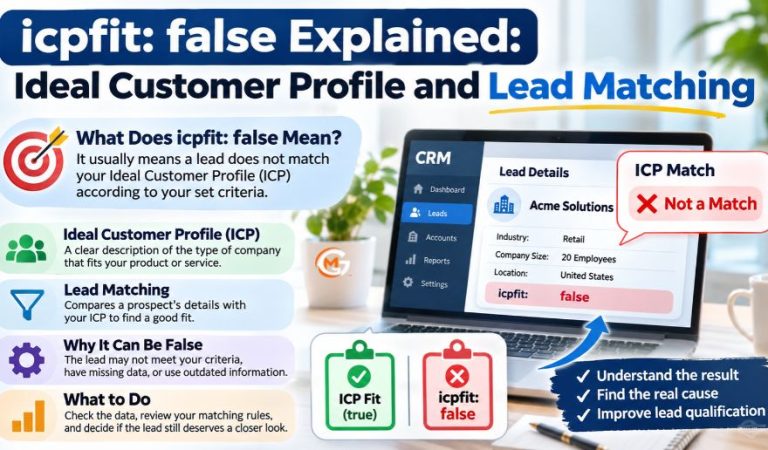
In sales and customer relationship management systems, businesses use data to identify promising customers. During this process, you might encounter the expression icpfit: false in a dashboard, data export, or software configuration. Although it looks technical, understanding its possible meaning is useful for anyone working with customer information.
In a sales context, this expression may indicate that a prospect does not match an Ideal Customer Profile (ICP). However, the exact meaning depends on the software and how the field is configured.
This guide explains ICP matching, why negative results appear, how to investigate them, and how businesses can improve lead qualification.
Quick Bio: Key Facts at a Glance
| Detail | Information |
|---|---|
| Expression | icpfit: false |
| Possible meaning of ICP | Ideal Customer Profile |
| Type of expression | Field and value |
| Value shown | Boolean false |
| Opposite Boolean value | true |
| Universal CRM standard? | No verified shared definition |
| Likely business context | Lead or account matching |
| Other possible context | Custom software setting |
| Common users | Sales and operations teams |
| Possible input data | Industry and company size |
| Additional matching factor | Location or business needs |
| Typical interpretation | A condition was not met |
| Automatic rejection? | Not necessarily |
| First troubleshooting step | Identify the source system |
What Does icpfit: false Mean?
The expression contains a name, icpfit, and a value, false. In programming, false is a Boolean value, often used when a test returns a negative result or a setting is disabled. If a sales application defines the field as Ideal Customer Profile fit, the value could mean that a lead failed one or more matching conditions. It does not prove that the lead is worthless, and it is not a universal CRM error code. A different application could use the same field name for another purpose. Always check the field definition before interpreting the result.
What Is an Ideal Customer Profile?
An Ideal Customer Profile describes the type of organization most likely to benefit from a company’s product or service. Businesses often build one by looking at customers who buy successfully, stay satisfied, and have needs the product can solve. Common criteria include industry, employee count, annual revenue, location, and business challenges. The profile helps teams decide where to focus their attention. Unlike a buyer persona, which describes an individual involved in purchasing, an ICP usually describes a suitable company or account. A company may match the profile even when its first contact is not the decision-maker.
How Ideal Customer Profile Matching Works
A business first sets its qualification rules. Imagine a software provider that mainly serves UK and U.S. logistics companies with 50 to 500 employees. Its matching process may compare a new account’s industry, country, and size against those requirements. A company outside the chosen range might receive a negative fit result. This is an example, not a confirmed calculation used by a particular CRM.
Some organizations use strict rules: every essential condition must be satisfied. Others give points to several traits and classify companies according to their total. A CRM may calculate results from its own records or information received through another system. The result is only as reliable as the data, business logic, and timing of that assessment.
Why a Lead Might Receive a False Result
A Genuine Mismatch
The prospect may fall outside the target industry, market, company size, or service area. That does not mean the company could never purchase. It means the account does not fit the specific profile used for this assessment. For example, a small local retailer might not qualify for a product designed for multinational manufacturers.
Missing or Outdated Customer Data
A false result can also reflect a technical or information problem. Employee counts may be old, industry labels may be inconsistent, or required fields may be blank. Some systems treat missing values as failed conditions; others keep them unknown until more information arrives. Rules that were suitable last year may also miss new market segments after a business changes its offering.
Where You Might See ICP Fit Information
Sales teams can store customer-fit indicators in CRM contact or company records, dashboards, and lead-routing workflows. A custom property might help decide which prospects enter an outreach queue or receive manual review. Data integration tools may pass similar fields between marketing platforms and sales databases. However, a field visible in an API response does not necessarily have the same name or meaning in the user interface. A negative value only triggers an action if the organization has configured one.
Understanding the Technical Format
Written as icpfit: false, the expression resembles a YAML key-and-value entry. In JSON, the equivalent illustrative format would be "icpfit": false inside an object. The unquoted word false is a Boolean, while "false" is text; confusing the two can affect integrations. A missing value such as null is also different from an explicit false result, although applications sometimes handle them in similar ways. Developers should check the field type, capitalization, expected format, and surrounding data rather than assuming the label identifies a particular product.
Mast Read: 001-gdl1ghbstssxzv3os4rfaa-3687053746: A Simple Guide for Beginners
How to Investigate an Unexpected Negative Match
Check the Field and Customer Record
Start with the application name and the screen, export, or API endpoint where the result appears. Find out whether icpfit is a custom property, a calculated score, or a configuration switch. Then inspect the prospect’s industry, location, size, and other required attributes. Compare those details with the current ICP rules. If information came from an outside data provider, verify that the right company and account were matched.
Review Rules, Integrations, and Refresh Timing
Next, inspect any automation that computes or copies the value. Check for incorrect field mapping, mismatched data types, overly strict conditions, and records that have not been reassessed after an update. Correct source information first, then rerun the evaluation if your system allows it. Avoid manually changing false to true simply to move a lead through a workflow; that can hide the cause and damage reporting accuracy.
What Should Sales Teams Do With a Negative Fit?
A negative fit flag is best treated as a prompt for a decision, not an automatic rejection. Teams might review valuable exceptions, place lower-priority accounts in a general follow-up group, or ask for missing information. Someone who actively requests a product demonstration deserves consideration even if an automated match is poor. Sales and marketing staff should agree on what a negative result means, who can override it, and when the account should be checked again.
Benefits and Limits of Boolean Lead Matching
A simple true-or-false indicator is easy to understand, filter, and use in routine workflows. It can help reduce time spent on accounts that clearly fall outside a business’s service area. But it also hides important differences: a company missing one small requirement can receive the same result as one that matches none. Bad data or narrow rules can exclude strong prospects. Review the reasons behind the result, especially before using it to block contact or close an opportunity.
Better Alternatives to Basic Yes-or-No Matching
Teams that need more detail can use fit tiers such as strong, possible, and weak, or weighted lead scoring that awards points for different characteristics. Engagement measures actions such as meeting requests and product inquiries, while buying intent may suggest purchase interest. Neither is the same as company fit. Combining these signals can improve prioritization, but a more complex model still needs reliable data and regular checks to prevent misleading scores.
Responsible Use of Customer Information
Customer matching often relies on business contact details and information about employees. Collect only the data needed for a clear business purpose, limit access, and follow applicable privacy rules where prospects live or work. Do not infer sensitive personal traits to decide whether someone deserves attention. Keep a way to correct inaccurate records and review automated decisions that could unfairly exclude legitimate customers.
Final Thoughts
The expression icpfit: false is not a standard error with one fixed solution. In software that uses icpfit for Ideal Customer Profile matching, it may mean an account does not meet current qualification rules. It could also reflect incomplete data, an old calculation, or a different technical setting. Identify the source, check the rules, and use the result as guidance rather than a final verdict on a prospect.
FAQs
What does icpfit: false mean in a CRM?
If the CRM defines icpfit as an Ideal Customer Profile field, false may mean a prospect did not satisfy its matching rules. Check the property definition because the exact field name is not standardized across platforms.
Is icpfit: false an error message?
Not necessarily. False is a normal Boolean value. It may represent a valid negative result or a disabled setting. An actual problem depends on whether the surrounding application expected another value or behavior.
Does a false result mean the lead is unqualified?
No. It may indicate poor fit with one chosen profile, not a complete lack of sales potential. A sales representative can review unusual cases, buying interest, and missing information before deciding what to do next.
What are the most common causes of a negative ICP match?
Common explanations include industry mismatch, company size outside the target range, unsupported location, and missing business details. Outdated records or incorrect matching rules can also produce results that deserve closer review.
Can missing customer details cause icpfit: false?
Yes, depending on the software. Some systems treat empty required fields as failed tests. Others return unknown or leave the assessment incomplete. Check the logic before assuming missing information means the company is unsuitable.
How can I change icpfit: false to true?
First verify the customer details and qualification conditions. Fix incorrect source records and run the matching process again where supported. Change the result manually only when your organization’s rules allow a justified override.
What is the difference between ICP fit and lead scoring?
ICP fit measures how closely a prospect matches your preferred customer type. Lead scoring may also consider behavior, engagement, or intent. A company can match your profile but show little interest in buying right now.
Can an ICP fit result change over time?
Yes. Companies grow, enter new markets, and develop new needs. Your business may also revise its target profile. When records or rules change, a fresh evaluation may produce a different result from an earlier one.
For More News and Daily Updates Visit: Gigly Magazine
