

Keibann is a term that appears in online articles about organization, Japanese language, and productivity. Yet its meaning is not as clear as some explanations suggest. Readers may find different definitions depending on which website they visit.
Some writers connect Keibann with visual task boards, where work moves through simple stages. Others associate it with Japanese words that have separate, established meanings. These connections deserve careful explanation rather than guesswork.
This guide explains what can be confirmed, why the term causes confusion, and how to use the practical task-management ideas often linked to it. It also covers useful alternatives and ways to check unfamiliar claims.
Quick info: Keibann at a Glance
| Detail | Information |
|---|---|
| Term | Keibann |
| General status | Ambiguous online expression |
| Standard definition | Not established |
| Confirmed origin | Not documented |
| Common online context | Organization and workflow |
| Documented related method | Kanban |
| Related Japanese word | Keijiban |
| Keijiban meaning | Bulletin or notice board |
| Typical board format | Cards and columns |
| Example stages | To Do, Doing, Done |
| Possible users | Individuals and teams |
| Physical setup | Paper or whiteboard |
| Digital setup | Existing planning software |
| Official Keibann product | Not reliably established |
What Is Keibann?
Keibann has no single, widely accepted definition supported by an established dictionary, technical standard, or recognized organization. Many recent web articles use the word when discussing simple visual workflows. In that context, it describes an informal way to see tasks, show progress, and keep work organized. That does not make it a separate, proven management framework. A reader who encounters the term should first identify the subject of the page: task planning, Japanese language, or something else.
Why Does Keibann Mean Different Things Online?
The confusion comes partly from similar spellings and partly from articles presenting different interpretations as facts. One page might call it a productivity system, while another connects it to compact Japanese vehicles or a cultural practice. Those claims cannot all establish the same definition. A helpful explanation should distinguish an informal label from a documented concept and should not invent an inventor, launch date, certification, or official feature list. If a description sounds unusually specific, look for evidence beyond similar articles.
Is Keibann a Japanese Word?
The spelling Keibann resembles real Japanese terms, but that similarity does not confirm a Japanese origin. Kanban commonly means a signboard and names a well-documented visual method used in manufacturing and knowledge work. Keijiban means a bulletin board or notice board; it may refer to a physical display or an online message board. Japan also has a category of small vehicles known as kei cars, including compact vans. None of these meanings makes Keibann their official alternative spelling.
Keibann vs. Kanban: What Is the Difference?
Kanban has a recorded history in Toyota’s production practices and is now used to manage many kinds of work. A Kanban board visualizes tasks, while the broader method also emphasizes managing flow, limiting work in progress, and improving how work moves through a process. Keibann, by contrast, has no comparable recognized guide or agreed rules. When an online article describes moving cards between columns under the Keibann name, it is describing something very close to a basic Kanban board.
How Does a Keibann-Style Workflow Work?
Mast Read: Arreed Explained: Meaning, Background, and Interesting Facts
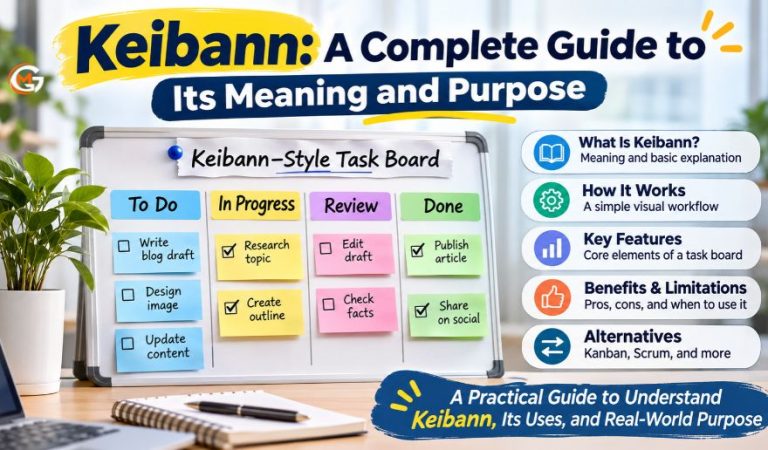
Imagine a small business preparing a weekly newsletter. Its board has four columns: To Do, In Progress, Review, and Done. Each newsletter task starts in To Do. A writer moves the draft to In Progress, an editor moves it to Review, and the finished issue reaches Done. Everyone can see what is happening without asking for constant updates. The board works only when people move cards as work changes. This example illustrates an ordinary visual workflow, not a confirmed proprietary system called Keibann.
Main Elements of a Useful Visual Task Board
A practical board needs recognizable tasks, clear columns, and an agreed definition of completion. Each card should name one result, its owner, and any important deadline. Teams can also set a work-in-progress limit, such as allowing only two items in the active column. That encourages people to finish existing work before starting more. Add a blocked marker when something cannot move forward. These are established planning practices, not exclusive features of a Keibann application.
How to Create a Simple Keibann-Style Board
Start with a whiteboard, sticky notes, a spreadsheet, or a familiar digital planning tool. Write down the tasks that actually need attention this week. Then create three or four stages that match how the work happens. Use short action titles such as “Review homepage copy” instead of vague labels such as “Website.” Assign an owner if several people are involved. Choose one clear rule for when a card can move to the next stage.
Review the board at a regular time, perhaps each morning or twice a week. Move completed tasks, flag anything blocked, and decide which unfinished item deserves attention next. If the In Progress column becomes crowded, stop adding new work until some tasks finish. At the end of the week, check whether the board revealed delays or simply recorded them. Adjust the stages only when they no longer reflect reality.
Where Can This Approach Be Useful?
Visual planning can help students organize assignments, freelancers track client requests, and households coordinate repairs or errands. In a workplace, a small team might follow design reviews, content production, customer requests, or routine maintenance. It is less useful for activities that cannot be broken into meaningful steps or that depend on detailed scheduling and complex relationships. For those projects, a calendar, timeline, or specialized management tool may provide a clearer view than cards alone.
Benefits and Limitations to Consider
The main benefit of a visual board is shared clarity. People can see what remains, what has started, and what has finished. It can reveal bottlenecks, reduce forgotten requests, and make handoffs easier. It also works at many scales: a personal board on paper can be as useful as a digital board for a small group. Beginners do not need advanced software or formal training to try the basic idea.
There are real limitations. Cards do not automatically estimate effort, resolve conflicting priorities, or explain why work is delayed. A board can become outdated if nobody maintains it. Large projects may need task dependencies, budgets, reporting, and access controls beyond a basic setup. Treat this approach as one planning aid, not as a guaranteed way to increase productivity or replace every other project-management practice.
Common Problems and Practical Fixes
If too many cards pile up in In Progress, reduce simultaneous assignments and finish the oldest useful task first. If items remain stuck in Review, clarify who must approve them and how quickly feedback is expected. When cards are confusing, rewrite them with one visible outcome and a responsible person. If people forget to update the board, make a two-minute review part of an existing routine rather than scheduling another long meeting. These fixes address everyday workflow problems; they do not require a special product, subscription, or named methodology.
Better-Documented Alternatives
For ongoing work with frequent incoming requests, Kanban offers established guidance on visualizing tasks, limiting work in progress, and improving flow. Scrum is another recognized framework, designed for teams working toward product goals through time-limited Sprints and planned reviews. A simple to-do list can be better for someone managing a few independent tasks, while a calendar handles appointments and fixed dates. A basic board may be enough; a more formal approach is useful when coordination becomes difficult.
How to Check Websites and Apps Using the Name
Because Keibann lacks a confirmed official identity, examine any website that presents itself as the definitive service. Look for a clear company name, contact details, understandable terms, and a description of what the tool actually does. Check whether prices and cancellation conditions are visible before payment. Avoid sharing sensitive files or granting broad account permissions merely to test an unfamiliar app. If you only need a task board, you can begin with paper or software whose operator and privacy controls are already clear.
Final Thoughts
Keibann is best understood as an ambiguous online term, not a verified Japanese productivity method or a clearly established software brand. Many explanations point toward useful visual task management, but those ideas are already well documented under Kanban and related planning practices. If a simple board helps you organize work, use it. Just separate practical advice from unsupported claims about the name, its history, or supposedly unique features.
FAQs
What does Keibann mean?
There is no single widely verified meaning. Online writers often use Keibann when discussing visual organization or task planning, but other explanations exist. Read the context carefully instead of assuming that every mention refers to the same tool or method.
Is Keibann an official Japanese word?
A standard Japanese definition for this exact spelling has not been reliably established. It may be confused with kanban, a signboard and workflow term, or keijiban, meaning a bulletin or notice board. These are distinct, documented words.
Is Keibann the same as Kanban?
No. Kanban is an established method with documented principles and practical guidance. Keibann is an uncertain label sometimes used for similar-looking visual boards. If you want to follow a recognized system, look for Kanban guidance rather than assuming the names are interchangeable.
What is the purpose of a Keibann-style board?
Its practical purpose is to make tasks and their status visible. A board can help an individual choose the next action or let a team spot delays. This describes a generic visual planning setup, not a confirmed official Keibann product.
How do beginners use this approach?
Write one task on each card, place the cards in To Do, and move them as work starts and finishes. Review the board regularly and keep the stages simple. Paper, sticky notes, or a basic digital board can all work.
Does Keibann have an official app?
No widely documented official app has been established for the term. That does not rule out individual products using the name. Before installing anything, confirm who operates it, what permissions it requests, and whether its advertised functions can be independently checked.
Can I try a Keibann-style system for free?
Yes. The underlying task-board idea requires no payment. You can draw columns on paper, use sticky notes, or choose a free planning tool. Review the limits of any free software plan before storing important work or inviting others to collaborate.
What is the best alternative to Keibann?
Kanban is the closest established match when you want a visual workflow. Scrum may suit a product team that benefits from structured Sprints. For personal reminders and fixed appointments, a simple task list or calendar may be more straightforward.
