

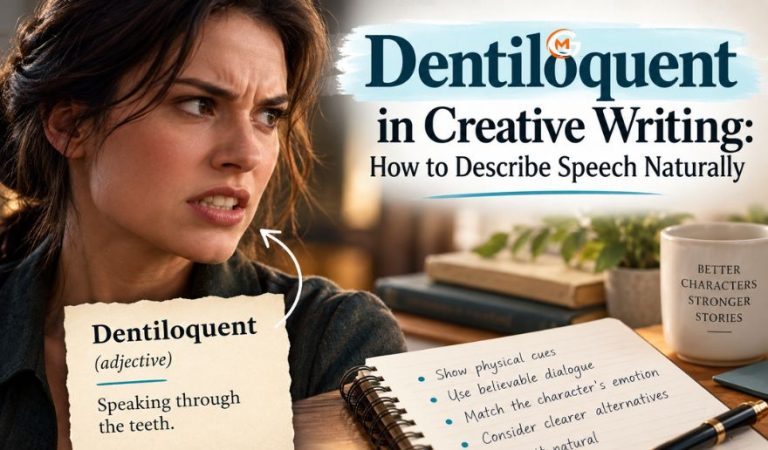
Dentiloquent is an extremely rare English adjective meaning speaking through the teeth. In creative writing, it can describe a character who delivers words while keeping their teeth close together, perhaps with a tense jaw or little mouth movement. It describes delivery, not emotion.
Writers may seek it for a strained reply, but most readers will better understand the familiar expression “through clenched teeth.” Choosing between them depends on the scene, narrative style, and intended audience.
The challenge is to describe speech accurately, reveal character, and keep scenes moving. The examples below show how dialogue, action beats, and clear alternatives can communicate the same physical detail without sacrificing a natural narrative voice.
What Does Dentiloquent Mean in Creative Writing?
The basic meaning is speaking through the teeth. Imagine someone trying to answer without opening their mouth very far. Their jaw may appear set, and the words might sound constrained. Calling that delivery dentiloquent describes the physical action rather than the content of the sentence.
What the Reader Should Picture
The teeth may stay close together, with little movement of the jaw. A writer can describe these details to help readers visualize the character’s behavior.
“Clenched teeth” suggests more tension than teeth merely held close. Choose whichever description matches the scene and the character’s physical behavior.
What the Word Does Not Tell You
Dentiloquent does not automatically mean angry, secretive, threatening, or in pain. It does not mean whispering or mumbling, either. A character’s reason for speaking this way must come from the surrounding circumstances, actions, and words.
The same rigid jaw could accompany suppressed tears or a discreet warning. Readers need context to understand what the behavior communicates.
Where the Word Comes From and How It Functions
The structure of the word reflects Latin elements associated with teeth and speaking. The dent- part relates to dens or dentis, meaning tooth; the -loquent part belongs to a family connected with loqui, meaning to speak. The related noun dentiloquy describes speaking through the teeth or with them closed.
The adjective appears in historical vocabulary sources but is not widely used today. Collins places it in its New Word Suggestion section, where it remains monitored for evidence of usage. It is not a familiar everyday expression.
Grammatically, it can modify a noun: “a dentiloquent reply,” “a dentiloquent speaker,” or “dentiloquent speech.” These are possible constructions, not expressions readers will necessarily recognize.
How to Use Dentiloquent Naturally in a Story
Let the Context Explain the Meaning
When using an unfamiliar word, give the reader something visible to connect it with. Compare “She made a dentiloquent remark” with “Her teeth barely parted as she gave a dentiloquent reply.” The second sentence makes the meaning easier to infer, although the description may make the rare adjective unnecessary.
If you must explain the word every time, consider removing it. Keep it when the narrator’s voice or rhythm makes it worthwhile.
Keep It in the Narration, Not Forced Dialogue
A literary narrator might choose a rare adjective. A character speaking casually to a friend probably would not say, “Your answer was dentiloquent,” unless that character has a special interest in obscure vocabulary.
Word choice should belong to the speaker or narrator, not merely to the writer’s vocabulary list. It may fit stylized prose better than a fast-moving contemporary exchange.
Use It Once When Once Is Enough
Establish a character’s habit with one clear observation, then let the dialogue carry it. Repeated labels draw attention away from the exchange.
If readers already understand how a character speaks under pressure, another detailed description might interrupt the conversation rather than strengthen it.
Describing Speech Through Dialogue and Action
Dialogue gives the words; action beats show movements around them. Together they can convey tight-jawed speech without an unfamiliar adjective.
Choose Dialogue Tags for Clarity
A dialogue tag identifies the speaker: “I understand,” Mara said. Add descriptions of manner sparingly because dialogue often communicates emotion already.
Compare “Don’t touch it,” she said angrily with “Don’t touch it,” she said through clenched teeth.
The second gives a more specific physical image. Whether that image suggests anger, fear, or determination depends on the scene.
Use Action Beats for Visible Tension
An action beat can show what a camera might capture:
Mara pressed her molars together. “I told you to leave it.”
The movement creates an image and places a pause before the spoken words. Readers can interpret the tension without being told exactly how Mara feels.
Avoid stacking a clenched jaw, grinding teeth, and a strained voice in one line. One convincing detail is enough; a plain “she said” can handle the next line.
Control the Pace of the Exchange
Short replies and pauses can suggest restraint, but not every tense character speaks in fragments. Keep the speech pattern consistent with the person and the situation.
Long descriptions weaken a rapid argument; a quiet confrontation may benefit from one deliberate pause.
How Speech Descriptions Suggest Character Emotions
Physical cues need context. A set jaw could suggest withheld anger or an effort to stay composed. Writers should connect a character’s movements with the situation instead of expecting one expression to explain everything.
Suppressed Anger and Frustration
Suppose a supervisor criticizes a character in front of colleagues. The character replies politely but keeps their teeth close together. Readers may infer that disagreement is being held back because the public setting makes an open argument costly.
The contrast between polite words and physical tension makes an additional statement such as “He was furious” unnecessary.
Fear, Pain, and Deliberate Restraint
A person might speak carefully while trying not to attract attention. Another might keep their jaw still because moving it is uncomfortable.
In these scenes, the same speech description serves different purposes; it should not be turned into a universal signal of aggression. Connect the delivery to a nearby listener, injury, difficult decision, or suppressed tears.
Mast Read: Agtalk Beginner’s Guide: How to Register, Browse, and Join Discussions
Dentiloquent Sentence Examples and Stronger Rewrites
These original examples contrast labels with descriptions readers can picture. Each revision focuses on making the character’s speech understandable without adding unnecessary explanation.
Example 1: An Argument at Home
Less effective:
“You always do this,” he replied dentiloquently, with a dentiloquent expression of anger.
Stronger:
His teeth barely parted. “You always do this.”
The revision replaces repetition with a visible action. “His dentiloquent reply ended the argument” might fit a formal narrator, but it is less visual.
Example 2: A Quiet Warning
Less effective:
She was dentiloquent as she told him to be careful.
Stronger:
“Careful,” she said through her teeth. Her eyes flicked toward the open door.
The glance toward the door suggests someone could be listening, without implying anger. The description adds a reason for her restrained delivery.
Example 3: A Character Trying to Stay Calm
Less effective:
“That’s wonderful,” she said in a very angry, tight, dentiloquent voice.
Stronger:
“That’s wonderful,” she said. She kept her jaw set until the guests had gone.
Polite words now contrast with physical tension, leaving readers to infer what she feels.
Example 4: When the Rare Word Fits
A deliberately bookish narrator might write:
“His dentiloquent congratulations came with a smile that never reached his eyes.”
Here the unusual adjective may belong to a distinctive narrative voice, while the second detail supplies the social context.
That choice works best when the surrounding prose shares its formal register. Otherwise, a simpler description may feel more natural.
When This Kind of Speech Fits a Scene
Restricted speech matters when a character has a reason not to speak openly. The description should help readers understand the character’s immediate circumstances.
Public Disagreement
At dinner or a workplace meeting, a restrained reply can conceal disagreement and create tension.
A character may avoid expressing frustration openly because other people are present. Their controlled delivery reveals something that their polite words do not.
Private Conflict
During an argument, a clenched jaw can suggest careful word choice or an effort to protect a friendship.
The character might be deciding whether to continue the disagreement or withdraw from it.
A Moment of Physical Discomfort
If a character’s jaw hurts, restricted movement may be practical rather than emotional. Establish the cause so readers do not assume the person is angry.
A useful test is whether deleting the speech description would remove important information. If the answer is no, the scene may not need it.
Match Speech Descriptions to Character and Narrative Voice
Two characters can say identical words and mean different things. A reserved person might tighten their jaw instead of protesting; an outspoken person might do so only when they are unusually frightened. Description gains meaning from the behavior readers have already seen.
The narrator matters as much as the character. In close third-person narration, wording usually reflects the viewpoint character’s perceptions and vocabulary. A teenager who thinks in everyday language may notice that a teacher “spoke through his teeth,” not classify the delivery as dentiloquent.
A distant, ornate narrator has more freedom to select rare words. Even then, consistency matters. If the rest of the page is clear and conversational, the unusual adjective may feel like a sudden change in voice.
An unfamiliar word should repay the effort of interpreting it. When it adds nothing, simplify.
Common Mistakes When Describing Speech Through the Teeth
Assuming the Physical Cue Proves Anger
Clenched teeth do not prove anger. A character might be frightened, uncomfortable, or struggling to remain composed.
Let context support the intended emotion instead of using a physical movement as a complete explanation.
Combining Too Many Descriptions
“He growled harshly through tightly clenched teeth in a furious voice” pushes several signals toward the same conclusion.
Try “He spoke through clenched teeth” and let his words or actions carry the remaining tension. Strong prose often depends on selecting the right detail, not collecting every possible one.
Applying the Term to Every Quiet Voice
Speaking softly, whispering, and speaking through the teeth are different descriptions.
A character may lower their voice while leaving their jaw relaxed. Volume and jaw position are different features; describe the one you mean.
Ignoring the Reader’s Point of View
In a telephone conversation, the listener cannot normally see the other person’s jaw.
A narrator limited to that listener’s experience should describe an audible strain or pause instead, unless the character has another reason to know how the speaker is moving.
Advantages and Limits of Unusual Speech Vocabulary
When It Can Help
Dentiloquent offers a compact, narrowly focused description and may contribute to the voice of a scholarly, humorous, historical-sounding, or deliberately elaborate narrator.
It can also prompt a writer to think more carefully about physical speech delivery instead of reaching for a generic emotional adverb.
A rare word is not automatically more precise in practice, however. Precision works only when the audience can interpret what has been said, either through familiarity or context.
When It Gets in the Way
Most readers will not recognize the adjective immediately. Stopping to decode it can interrupt a tense exchange, and repeating it can make character dialogue sound studied.
The related expression “through clenched teeth” is usually clearer, particularly when the moment needs to move quickly. Judge whether the unusual word genuinely helps the sentence.
Clearer Alternatives to Dentiloquent
“Through Clenched Teeth”
This familiar phrase presents a strong image of tension and is often the closest practical substitute.
It can imply suppressed anger or effort, although the scene should establish the reason. Use it when the mouth is held tightly rather than merely moving little.
“With His Jaw Set” or “Barely Opening Her Mouth”
These descriptions emphasize what another character can see.
They are useful when physical restraint matters but the writer does not want to assume a particular sound or emotion. They also fit naturally into an action beat.
“In a Tight Voice” or “In a Strained Voice”
These phrases emphasize the audible quality of speech. They are useful when the viewpoint character can hear but not see the speaker.
Neither proves that the teeth are together, so they are alternatives for an intended effect rather than exact synonyms.
Muttering, Mumbling, and Whispering
Muttering suggests speaking quietly, often to oneself or in a complaining manner; mumbling emphasizes unclear articulation; whispering describes a low, breathy manner of speaking.
None means the same thing as speaking through the teeth. Choose one only when that feature is actually present.
A Simple Editing Checklist for Speech Descriptions
When revising a scene, read the dialogue aloud and picture the movement around each line. Ask whether the physical description makes the exchange clearer or merely slows it down.
- Identify the observable detail. Is the jaw set, the mouth barely open, or the voice audibly strained?
- Check the cause. Does the surrounding scene support the emotion readers are likely to infer?
- Respect viewpoint. Can the narrator reasonably see or hear the detail being described?
- Remove duplicates. One clear cue often replaces several adjectives and adverbs.
- Test the simpler version. Does “through clenched teeth” communicate more quickly than the rare word?
- Keep dialogue readable. Use ordinary tags and occasional action beats so readers never lose track of speakers.
Keep descriptions that clarify how and why a line is spoken.
Final Thoughts
Dentiloquent names a specific physical manner of speaking, but it remains an extremely uncommon word. It can suit a distinctive narrative voice, yet its rarity often makes a plain description more effective for a broad audience.
To describe speech naturally, start with the character’s situation, choose one believable physical or audible cue, and let the dialogue provide emotional context.
Keep the unusual word only if it genuinely strengthens the sentence. Clear descriptions and believable character behavior should always matter more than unusual vocabulary.
FAQs
Is Dentiloquent a Real English Word?
It is historically documented, but it is extremely rare. Collins currently lists it as a New Word Suggestion being monitored for usage, so it should not be presented as a familiar modern dictionary staple.
How Do You Use Dentiloquent in a Sentence?
It functions as an adjective, as in “She gave a dentiloquent reply.” Because many readers will not know it, nearby descriptions of a nearly closed mouth or tense jaw can help establish its intended meaning.
Does Dentiloquent Always Mean Speaking Angrily?
No. It describes speech through the teeth rather than a specific emotion. A character might speak that way from frustration, self-control, fear, or discomfort; the scene must establish which explanation fits.
What Is the Difference Between Dentiloquent and Dentiloquy?
Dentiloquent is an adjective describing a manner of speech. Dentiloquy is a related noun referring to the act or habit of speaking through the teeth. Both are unusual terms rather than everyday conversation words.
Can Dentiloquent Describe Whispering or Quiet Speech?
Only if the person is also speaking through the teeth. Whispering primarily concerns vocal delivery and volume, not a tightly held jaw. Quiet speech alone is not enough to justify the adjective.
What Are Some Simpler Alternatives to Dentiloquent?
“Through clenched teeth” is the closest familiar expression when the jaw is tense. “Barely opening her mouth” emphasizes a visible movement, while “in a strained voice” describes what another person might hear.
Is Dentiloquent Suitable for Modern Fiction and Dialogue?
It can work in modern fiction when it suits the narrator or character, but most readers may find it distracting. In ordinary spoken dialogue, a straightforward phrase will often sound more believable.
How Can Writers Describe Speech Naturally Without Unusual Words?
Combine clear dialogue with a small action or audible detail that matters to the scene. Avoid naming every emotion, keep speakers easy to identify, and remove descriptions that repeat information readers already understand.
For More News and Daily Updates Visit: Gigly Magazine
