

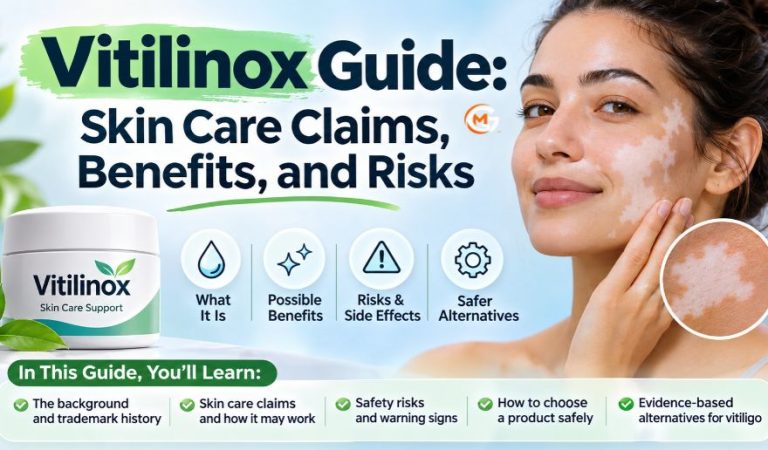
Vitilinox is a name that appears in discussions about skin care, uneven pigmentation, and vitiligo. Readers want to know what it contains and whether it can restore color to white patches.
The name has a documented trademark history in India. However, a trademark record does not tell us what a current product contains, whether it is available to buy, or whether it has been tested on people with vitiligo. These details remain unclear.
This guide covers the evidence, possible risks, buying precautions, and established care options. It also explains why everyday skin care and medical treatment should not be treated as the same thing.
Vitilinox Quick Bio
| Detail | Information |
|---|---|
| Name | Vitilinox |
| Documented identity | Commercial trademark |
| Original applicant | Curatio Health Care (I) Private Limited |
| Filing country | India |
| Filing date | April 2, 2018 |
| Cosmetic trademark | Class 3 |
| Medicinal trademark | Class 5 |
| Application number, Class 3 | 3794236 |
| Application number, Class 5 | 3794237 |
| Corporate connection | Torrent Pharmaceuticals |
| Common online association | Pigmentation and vitiligo |
| Confirmed product format | Not established |
| Verified ingredient formula | Not established |
| Proven vitiligo benefit | Not established |
| Reliable retail price | Not established |
What Is Vitilinox?
Vitilinox is best described as a documented commercial name, not a confirmed medical treatment. Online descriptions sometimes connect it with products meant for skin discoloration or white patches. Yet the available trademark information does not establish whether a current item sold under this name is a lotion, cream, medicine, or supplement. Identify the exact item and its directions before considering use.
The Company and Trademark History
Curatio Health Care, an Indian dermatology business, filed applications for the Vitilinox name on April 2, 2018. The recorded categories include Class 3, used for cosmetics, and Class 5, which covers medicinal and pharmaceutical goods. Both application numbers also appear in corporate trademark records. Registration does not prove product availability or medical approval.
Torrent Pharmaceuticals acquired Curatio in October 2022, adding its dermatology business to the company. That history does not authenticate online sellers using the name. Current branding, manufacturing details, and distribution should be checked independently rather than assumed from the acquisition.
Why Is Vitilinox Linked With Vitiligo?
Vitiligo is a long-term condition in which patches of skin lose pigment. The body’s immune system can attack melanocytes, the cells that produce melanin, which gives skin its color. The patches are not contagious. White patches also have other possible causes, including fungal conditions and changes after inflammation, so appearance alone cannot confirm vitiligo.
The similarity between the Vitilinox name and vitiligo may help explain why websites associate them. The name alone does not prove a medical purpose. A labeled product might moisturize, conceal color differences, or claim to affect pigmentation. Those are very different uses.
Skin Care Claims and Possible Benefits
Some descriptions of products associated with pigmentation care talk about softer skin, improved appearance, antioxidant support, or more even skin tone. Moisturizers can help dry skin feel comfortable, and camouflage cosmetics can make color differences less visible. Neither effect proves that lost melanin has returned. Without a verified formula and studies, these benefits cannot be credited to Vitilinox. Claims such as rapid repigmentation or permanent reversal of vitiligo deserve special caution.
Ingredients and How Pigmentation Treatments Work
No authenticated, complete ingredient list for a current Vitilinox product has been established here. References to herbs, vitamins, or antioxidants on third-party pages should therefore be treated as unconfirmed, not as a formula to rely on. Some ingredients moisturize; others irritate skin or act on specific biological pathways. A promising ingredient in a laboratory study does not prove that an unknown mixture will work on human skin.
In vitiligo, restoring color generally means helping functioning melanocytes produce pigment again in affected areas. That differs from simply making skin look smoother. Approved and prescribed treatments may influence immune activity or use controlled light exposure, but results take time and differ by body area. A cosmetic claim about a healthy-looking complexion should never be confused with evidence that a product can restart pigment production.
Mast Read: I Am a GenZ Man. How Does the NIVEA MEN Line Stack Up Against Bulldog or Lumin?
Is There Evidence That Vitilinox Works?
The critical missing piece is clinical evidence for an identifiable finished product. Researchers must know the ingredients, dose, participants, and measured outcomes. Before-and-after photographs or customer reviews cannot reliably answer those questions. Lighting, makeup, natural changes, and other treatment use can affect what pictures appear to show. At present, there is no solid basis for promising that Vitilinox treats vitiligo or restores pigment permanently.
How to Check a Product Before Using It
If you encounter a Vitilinox listing, first look for a manufacturer, complete ingredients, batch number, expiration date, product size, and instructions written for that specific formulation. Check whether the seller describes it as a cosmetic or medicine and whether any required local registration is verifiable. For a product that claims to treat a disease, ask for evidence involving that finished product rather than testimonials. Missing information is a good reason not to buy or apply it.
A sensible first-use check has three parts:
-
Confirm what the package contains and who made it.
-
Read the warnings and ask a pharmacist about possible interactions.
-
Follow only verified instructions; never invent a dose or frequency.
Do not put an unidentified preparation on broken skin, near your eyes, or over a large area. If you already use prescription creams or light treatment, speak with your clinician before adding anything new. A patch test may help assess irritation from an ordinary cosmetic, but it cannot prove that a product is safe for everyone or effective against vitiligo.
Safety Risks and Warning Signs
The side effects of Vitilinox cannot be listed with confidence without knowing the actual formula. In general, unfamiliar skin products may cause burning, itching, redness, swelling, or allergic contact dermatitis. Fragrance, plant extracts, and strong active ingredients can be triggers for some people. Stop using a product that causes irritation and seek medical guidance if symptoms persist. Sudden facial swelling, difficulty breathing, or a severe reaction needs urgent medical care.
A greater risk is delaying a proper diagnosis while trying an unsupported remedy. Children, pregnant or breastfeeding people, and anyone with damaged or highly sensitive skin should seek individual advice before using uncertain products. Watch for sellers that promise a cure in days, hide ingredient details, or claim medical approval without a traceable authorization. A familiar company name or professional-looking package is not enough to establish safety.
Where Can You Buy Vitilinox?
A verified official retail source and reliable standard price are not established, so naming a particular shop or cost would be guesswork. Availability may also vary across countries. Before paying, check the seller’s business details, return policy, contact information, and whether the item matches any manufacturer-confirmed packaging. Be wary of unusually cheap offers, pressure to order immediately, and websites that use a brand-like domain without proof of authorization. Save your receipt and label.
Better-Established Options for Vitiligo Care
Daily sun protection is a useful starting point. Vitiligo patches can burn easily because they contain less protective pigment. Choose a broad-spectrum sunscreen, usually SPF 30 or higher, and consider SPF 50 for extra protection, particularly in strong sunlight. Clothing and shade also help. Moisturizer eases dryness; camouflage makeup and self-tanner conceal contrast without restoring pigment.
For people who want repigmentation, a dermatologist may consider prescribed topical corticosteroids, tacrolimus or pimecrolimus in suitable cases, narrowband UVB phototherapy, or ruxolitinib cream where approved and appropriate. Ruxolitinib has specific approvals for certain patients with nonsegmental vitiligo, including in the United States and European Union; availability and eligibility vary elsewhere. No option guarantees lasting results. A dermatologist tailors care to individual needs.
Final Thoughts
Vitilinox has a real trademark history, but that fact does not prove a marketed product’s ingredients, safety, or ability to treat vitiligo. The most useful approach is to verify the exact formulation and seller, question dramatic claims, and avoid replacing established care with an unknown product. Anyone noticing new or changing white patches can benefit from a diagnosis and a treatment discussion based on their own skin and goals.
(FAQs)
What is Vitilinox used for?
Vitilinox is a trademark name that online discussions associate with skin pigmentation concerns. Its precise current product format and approved use have not been verified. Read the label of any item sold under that name before assuming it is meant to treat white patches.
Is Vitilinox a cream or a supplement?
Neither description is firmly confirmed for a current official product. Some websites may use different descriptions. Check the manufacturer, package type, and full label rather than trusting a search result or advertisement that does not identify the item clearly.
What ingredients does Vitilinox contain?
A reliable full formula is not available from the information verified here. Avoid treating unofficial lists of herbs, vitamins, or other compounds as confirmed ingredients. A pharmacist can help review a genuine package label for possible irritants or medicine interactions.
Can Vitilinox restore natural skin pigmentation?
There is not enough product-specific clinical evidence to say it can. Repigmentation is possible with some established vitiligo treatments, but results vary and usually develop slowly. An ordinary moisturizer or skin tint should not be expected to restore lost melanin.
Does Vitilinox permanently cure vitiligo?
No permanent cure has been established for vitiligo, and no evidence confirms Vitilinox as one. Medical treatment can sometimes bring back color or slow changes, but pigment may be lost again. Be cautious of anyone guaranteeing a permanent cure.
Is Vitilinox safe for sensitive skin?
Its safety cannot be judged without a verified ingredient list and product instructions. Sensitive skin may react to fragrance, botanical extracts, or active chemicals. Avoid unidentified products, and ask a dermatologist before use if you have eczema, allergies, or broken skin.
Is Vitilinox FDA approved?
A Vitilinox drug approval for treating vitiligo has not been verified. Registering a trademark is not the same as receiving approval from the U.S. Food and Drug Administration. Ask sellers for the exact medicine’s regulatory details before accepting approval claims.
What should I use instead of an unverified vitiligo product?
Start with sun protection and a gentle skin care routine. If you want to address lost pigment, a dermatologist can discuss prescription creams, light therapy, and other suitable options. Camouflage products are another choice when appearance, rather than repigmentation, is the goal.
For More News and Daily Updates Visit: Gigly Magazine
