

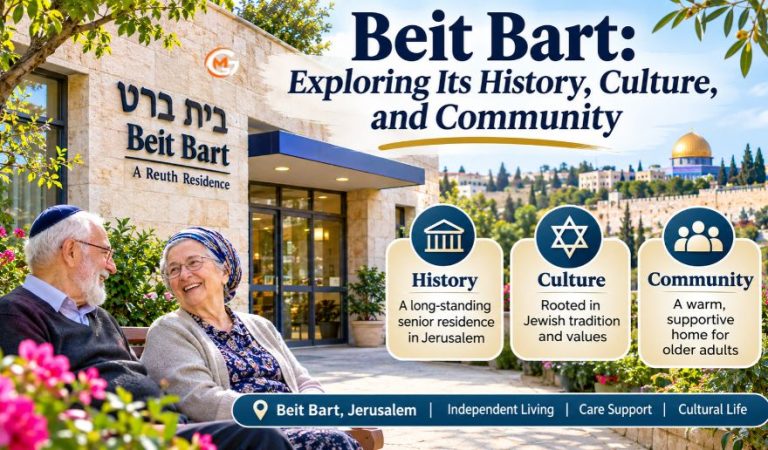
Later-life housing is about more than an apartment. People want familiar routines, helpful services, and neighbors who share their values. Beit Bart brings these needs together in a senior living community in Jerusalem.
Located in Baka, it belongs to Reuth, an Israeli nonprofit supporting older adults. Its religious-Zionist character shapes everyday life, from synagogue services to holiday gatherings and shared meals.
This guide explores its history, apartments, medical support, cultural life, and admissions. It also explains what prospective residents and families should check before making a decision.
Quick Bio of Beit Bart
| Detail | Information |
|---|---|
| Name | Beit Bart |
| Alternative spelling | Beit Barth |
| Hebrew name | בית ברט |
| Type | Senior living residence |
| Location | Jerusalem, Israel |
| Neighborhood | Baka (Bak’ah) |
| Street address | 56 Hebron Road |
| Operating organization | Reuth nonprofit |
| History | Operating since the 1980s |
| Primary residents | Older adults |
| Community character | Religious-Zionist Jewish |
| Housing model | Independent living with support options |
| Religious facilities | On-site synagogue |
| Healthcare | Routine medical support and supportive care |
| Main activities | Classes, gatherings, and cultural events |
What Is Beit Bart?
Beit Bart is a residential community for older adults who want private living space alongside practical help and regular opportunities to connect with others. It is sometimes described as a retirement home or protected housing. In Israel, this kind of setting can combine independent apartments with shared services, rather than functioning only as a nursing facility. The residence particularly serves people comfortable with a religious-Zionist Jewish lifestyle. That identity is part of the daily schedule, food arrangements, and communal celebrations. Residents still have individual needs and preferences.
The History of Beit Bart and Reuth
Roots in a Long-Running Nonprofit
Reuth began in Tel Aviv in 1937 as a social welfare effort. Its early work responded to the needs of people facing hardship, including immigrants and older adults. Over time, the nonprofit developed healthcare, rehabilitation, and senior housing programs. Beit Bart is one part of that wider story, not the organization that started in 1937. A Jerusalem court record states that Reuth established the residence and that it was already operating during the 1980s. The same record places the organization on the property by 1992, confirming its established history.
Changing Needs Over the Years
As residents grew older, demand for larger living spaces and different levels of assistance increased. Planning records from the 2010s describe proposals to change the building and improve its ability to support residents with greater care needs. A separate planning proposal was still moving through the approval process in 2026. Proposed construction is not the same as completed work. What matters is what is available today.
Where Is Beit Bart Located in Jerusalem?
The residence stands at 56 Hebron Road, known locally as Derech Hebron, in Jerusalem’s Baka neighborhood. This urban location helps residents stay connected to city life. Local directories describe nearby bus routes, stores, and everyday services. This can make errands and visits easier. Families should nevertheless check the walking route, traffic crossings, transport frequency, and accessibility of nearby destinations for the individual resident.
Apartments and Everyday Living Facilities
Private Space and Shared Amenities
Reuth describes apartments of different sizes, designed to support a comfortable daily routine. Its broader senior housing information mentions kitchen facilities, air conditioning, safety features, and the option to use personal furniture. Shared spaces offer places to meet neighbors, attend activities, or enjoy meals together. Residence listings also mention a library, dining room, and outdoor areas. Families should inspect the actual apartment and its accessibility.
Meals, Cleaning, and Maintenance
Practical services can reduce the work of maintaining a home. Reuth advertises regular cleaning and property maintenance within its housing network, along with meals that take residents’ needs into account. Independent living still allows room for personal preferences, including how people spend their time and which activities they attend. Before moving in, ask which meals are included, whether dietary needs can be met, and whether household assistance has an extra charge. Clear answers can prevent problems later.
Mast Read: Who Is Yuko Kubota? Everything About Josh Blue’s Ex-Wife
Medical Support and Resident Safety
Beit Bart is described by its operator as offering around-the-clock access to medical supervision, as well as a supportive care department for people whose needs have increased. Reuth’s housing network also lists routine medical services, nursing, physical therapy, and social work. These are meaningful advantages for residents who may need occasional help while keeping a degree of independence. However, a supportive department is not automatically the same as hospital treatment or a full nursing home. Families should ask about staffing levels, emergency response, medication management, transfers to hospitals, and what happens if a resident develops complex long-term care needs.
Religious Life, Culture, and Traditions
Prayer and Jewish Observances
A central feature of the home is its religious-Zionist atmosphere. The residence has a synagogue, with prayer and religious study forming part of community life. Shabbat and Jewish holidays also give the week a familiar rhythm through shared worship, meals, and family participation. These familiar customs may reassure residents. People considering the residence should ask about specific prayer times, kosher supervision, and how religious practice works alongside individual choice.
Learning and Cultural Events
Faith is only one part of the activity schedule. Descriptions of the residence and Reuth’s network include lectures, music, exercise, social gatherings, and opportunities for residents to contribute ideas. Activities help residents socialize and stay engaged. The best schedule is one that offers variety without making participation feel compulsory. Families can request a recent activity calendar to see what happens regularly, which sessions suit different mobility levels, and whether events are conducted in languages the resident understands.
Community Life and Family Connections
A senior residence can be welcoming on paper yet feel different in person. What matters is how neighbors interact, whether newcomers are included, and whether staff recognize residents as individuals. Reuth places particular emphasis on personal attention and family involvement. Its published resident stories also highlight people who brought long lives, memories, and interests into the community. Connections can matter after retirement or bereavement. A visit during an ordinary weekday can reveal more about the atmosphere than a formal presentation alone.
Who Is Beit Bart Best Suited For?
The residence is mainly relevant to older adults seeking independent housing with a religious Jewish community and available support. It may appeal to someone who values daily prayer, shared holiday traditions, and a location within Jerusalem. It may be less suitable for people who prefer a secular environment or require medical care beyond what the residence can currently provide. Admissions depend on individual needs and available accommodation. Families should discuss mobility, memory concerns, dietary requirements, language, daily assistance, and preferred level of privacy openly rather than assuming that every senior housing option works for everyone.
Admission Requirements and Costs
Public descriptions indicate that accommodation is privately financed, but a reliable current price list is not readily available. Fees can depend on apartment size, care needs, included services, and the contract offered. Families should request a written explanation of any entrance payment, monthly charges, extra medical or personal care fees, and conditions for leaving. Admission may also involve an assessment of a person’s health and ability to live safely in the residence. Asking about waiting lists and availability early is sensible, especially if the move needs to happen within a particular time frame.
Benefits, Limitations, and Alternatives
The main appeal is the combination of independent living, religious continuity, shared activities, and access to support. The location may also help residents stay connected to Jerusalem’s wider community. Yet there are limits: a faith-centered setting will not fit everyone, the cost must be checked, and available care may not cover every future medical need. Other possibilities include secular senior apartments, assisted living communities, home care, and nursing facilities. The right comparison is not simply which option has more amenities, but which one matches a person’s health, finances, preferred social life, and independence.
How to Plan a Visit and Make a Decision
A thoughtful visit should go beyond viewing a furnished apartment. Ask to see shared areas, speak with staff about the daily routine, and find out how residents report problems. Notice whether halls and bathrooms meet the person’s mobility needs. It also helps to ask about visiting hours, overnight guests, food choices, communication with families, and emergency procedures. If possible, compare more than one residence before signing an agreement. Written questions make comparisons easier.
Final Thoughts
Beit Bart represents a particular approach to senior living: a home environment shaped by Jewish tradition, community participation, and practical support. Its connection with Reuth and its long presence in Jerusalem give it an established place in the city’s senior housing landscape. Still, choosing a residence is a personal decision. The most useful next step is to confirm current accommodation, fees, care arrangements, and the everyday atmosphere in person, then decide whether they truly match the future resident’s needs.
(FAQs)
What is Beit Bart in Jerusalem?
Beit Bart is a senior living residence in Jerusalem offering private accommodation, communal activities, and support services. It is associated with the Reuth nonprofit and has a religious-Zionist Jewish community character.
Where is Beit Bart located?
It is located at 56 Hebron Road in the Baka neighborhood of Jerusalem, Israel. The area has public transportation and nearby everyday services, although accessibility should be checked for each resident.
Who operates Beit Bart?
The residence is operated by Reuth, an Israeli nonprofit active in senior housing, healthcare, and rehabilitation. Reuth’s history goes back to 1937, while Beit Bart itself has operated since the 1980s.
What is the history of Beit Bart?
The residence has served older adults in Jerusalem for decades. Legal records confirm it was operating in the 1980s. Later planning proposals reflect changing housing needs but do not establish which renovations are complete.
What religious and cultural activities are available?
The residence is known for synagogue life, Jewish holiday observances, classes, and social events. Music, lectures, and exercise are also associated with its programs. Ask for the current weekly schedule before deciding.
Does Beit Bart offer medical care?
Reuth describes medical supervision and a supportive care department at the residence. Families should clarify the exact level of nursing assistance, emergency coverage, specialist access, and arrangements for residents whose health needs increase.
How much does it cost to live at Beit Bart?
A verified current fee schedule is not publicly clear. Request a written quote showing accommodation charges, deposits if any, services included, and costs for extra care. Compare the full contract rather than one monthly figure.
How can someone apply to live at Beit Bart?
Start by contacting the residence to ask about vacancies and arrange a tour. Staff can explain eligibility, any health assessment, the application process, and costs. Prepare questions about the prospective resident’s personal care needs.
For More News and Daily Updates Visit: Gigly Magazine
