

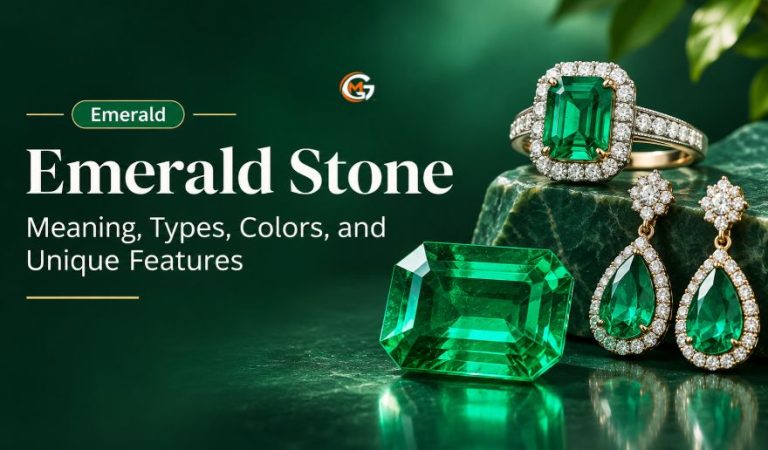
Emerald is one of the world’s best-known green gemstones. Its deep color, natural patterns, and long history make it a favorite for jewelry and gemstone collections. Fine examples can be valuable, but beautiful stones are available in a wide range of qualities and prices.
An Emerald belongs to the beryl mineral family, which also includes aquamarine. Its green color comes mainly from tiny amounts of chromium or vanadium within the crystal. Each stone can look different because its color, clarity, and natural features vary.
Understanding these differences helps you appreciate Emerald jewelry and shop with more confidence. This guide covers its meaning, main types, color variations, quality factors, treatments, everyday uses, and simple care tips.
Emerald Quick Bio: Key Facts at a Glance
| Detail | Information |
|---|---|
| Gemstone name | Emerald |
| Mineral family | Beryl |
| Mineral formula | Be₃Al₂Si₆O₁₈ |
| Typical color | Green to bluish green |
| Main coloring elements | Chromium and vanadium |
| Crystal system | Hexagonal |
| Mohs hardness | 7.5–8 |
| Common appearance | Transparent to included |
| Familiar cut | Rectangular emerald cut |
| Important sources | Colombia, Zambia, Brazil |
| Other sources | Zimbabwe, Afghanistan, Pakistan |
| Common treatment | Fracture filling with oil or resin |
| Traditional symbolism | Renewal, love, and hope |
| Birthstone month | May |
What Is an Emerald Stone?
Emerald is the green to bluish-green gem variety of beryl, a mineral made of beryllium, aluminum, silicon, and oxygen. Not every green beryl crystal is called an Emerald. Very pale examples may be classified simply as green beryl, and the dividing line can vary among experts. Unlike green glass or dyed quartz sold as a lookalike, genuine Emerald has a defined mineral composition and crystal structure. Its attraction comes from a rich combination of color, natural character, and relative rarity, especially in larger, transparent stones.
Emerald Meaning and Historical Significance
What Does the Green Gemstone Symbolize?
Across different cultures, people have associated Emerald with growth, new beginnings, harmony, and love. These meanings are traditions rather than proven effects of wearing the stone. Ancient Egyptians prized green gems, and Emerald later appeared in royal ornaments and luxury jewelry across Europe and Asia. Colombian deposits also became important to the global gemstone trade. Today, people often choose an Emerald as a May birthstone, an anniversary gift, or a personal symbol of renewal. Its cultural appeal adds meaning, but symbolism alone does not determine a stone’s quality or price.
How Emerald Forms and Where It Is Found
Emerald forms when the right elements meet under unusual geological conditions. Beryl needs beryllium, while its green color depends on chromium or vanadium. Bringing these elements together is uncommon, helping explain why attractive gem-quality crystals can be scarce. Colombia is famous for important deposits, while Zambia and Brazil also produce significant stones. Emeralds occur in countries such as Zimbabwe, Afghanistan, and Pakistan. Mining locations affect the geological setting and sometimes the features seen inside a gem, but country of origin alone cannot establish its quality. A laboratory may offer an origin opinion when testing supports one.
Emerald Colors: From Light Green to Deep Green
What Creates Its Different Shades?
The best-known Emerald color is a lively, saturated green, sometimes with a slight blue tint. Chromium and vanadium produce the green, while other trace elements, including iron, can influence its shade. Some stones look yellowish green; others appear cooler or more bluish green. A very pale beryl may not meet the usual definition of Emerald. Strong color is desirable, but a stone that looks almost black in ordinary light may be too dark. When shopping, view gems in more than one lighting condition and look for an even, pleasing color rather than relying on labels like “deep green.”
Main Types of Emerald and Their Differences
Geographic Varieties and Trapiche Emeralds
Sellers often describe stones as Colombian, Zambian, or Brazilian Emeralds. These names identify claimed geographic origins, not separate mineral species. Colombian stones are sometimes associated with rich green tones, while Zambian stones may show cooler shades, but their appearances overlap. Another striking form is the trapiche Emerald, which has dark, spoke-like patterns radiating through the crystal. Such patterns develop naturally and make each specimen unusual. Origin labels should be supported by reliable testing on costly purchases. Choose by the individual stone’s beauty and condition, not by a country name alone.
Mast Read: Fappelo: A Complete Guide to Its Website and Online Services
Unique Physical Features of Emerald
Hardness, Crystal Shape, and Natural Inclusions
Emerald measures 7.5 to 8 on the Mohs hardness scale, so it resists many scratches. However, hardness does not mean it cannot chip or break. Internal fractures can make a stone more vulnerable to knocks, particularly in rings. Rough crystals often grow as six-sided columns. Many finished stones contain inclusions, such as tiny minerals, fluid pockets, or fine fractures. These inner features are sometimes called jardin, the French word for garden. They can give an Emerald character, though heavy inclusions that block light or threaten durability may reduce its value.
What Determines Emerald Quality and Price?
Color, Clarity, Cut, and Carat Weight
Color usually carries the greatest weight when judging Emerald quality. Buyers value vivid, balanced green with good transparency. Clarity matters too, but visible inclusions are normal, and an eye-clean natural stone can be especially rare. Cutters shape crystals to show color while reducing stress on fragile areas. The familiar rectangular emerald cut has trimmed corners, though oval, pear, round, and other shapes are available. Carat measures weight, not size, and prices do not rise evenly with weight. A large, pale, heavily fractured stone may be worth less than a smaller, lively green gem. Treatments, origin evidence, and overall condition also influence prices.
Natural, Treated, Lab-Grown, and Imitation Emeralds
Understanding What You’re Buying
A natural Emerald forms in the Earth. Many natural stones receive clarity enhancement: oil or resin is placed into surface-reaching fractures so they look less visible. This treatment does not automatically make the gemstone fake, but the type and extent of filling matter. A lab-grown Emerald has essentially the same mineral composition as a natural one, yet forms in a controlled setting rather than underground. An imitation, such as green glass, may only copy its appearance. Ask sellers whether a stone is natural, laboratory-grown, treated, or simulated, and request written disclosures. Even attractive photos cannot reliably prove authenticity.
Popular Uses of Emerald in Jewelry
Emerald appears in engagement rings, pendants, necklaces, bracelets, earrings, and collectible loose stones. Its distinctive green looks striking beside yellow gold, white gold, silver, and diamonds. Earrings and pendants may face fewer daily knocks than rings, making them practical choices for delicate stones. For an everyday ring, a secure setting with protective edges can lower the chance of damage, although it cannot remove the risk. The main advantage is its unmistakable color; the main drawback is the care needed around impact, heat, and chemicals. Choose jewelry that suits how often and where you will wear it.
How to Buy a Good Emerald Without Common Mistakes
A Practical Buying Checklist
Start with a budget, then compare gems under normal lighting rather than judging from edited pictures. Look for pleasing color, useful transparency, a well-proportioned cut, and no obvious damage near exposed edges. Ask about oil, resin, or other enhancements and whether the seller offers a return period. An independent gemological report can help identify natural versus lab-grown material and detectable treatments; it is not always a price appraisal. Avoid assuming that darker means better, that all inclusions prove authenticity, or that a famous origin guarantees value. For expensive stones, verify the report details and seek a qualified independent opinion.
How to Clean and Protect Emerald Jewelry
Safe Cleaning and Common Problems
Use lukewarm water, mild soap, and a soft cloth or brush to clean most Emerald jewelry gently. Rinse carefully and dry it without rubbing hard. Avoid steam cleaners, ultrasonic machines, harsh chemicals, and sudden heat, especially when fractures have been filled. Remove rings before sports, housework, or other activities where they might receive a sharp knock. Store pieces separately from harder gemstones to reduce scratching. If a stone appears cloudy, develops a visible crack, or seems loose in its setting, stop wearing it and consult a qualified jeweler. Do not try to polish or refill it at home.
Final Thoughts
Emerald stands out for its green color, natural inclusions, and centuries of cultural meaning. The best choice is not always the biggest or darkest stone. Look closely at color, condition, treatments, and the setting, then buy from a seller who explains what you are getting. With sensible care, an Emerald can remain beautiful for many years.
(FAQs)
1. What Makes Emerald Different From Other Green Stones?
Emerald is a specific green variety of beryl. Green tourmaline, peridot, jade, and glass can resemble it, but they differ in mineral makeup, physical properties, and typical appearance. Color alone cannot confirm a gemstone’s identity.
2. What Is the Spiritual Meaning of Emerald?
Traditionally, Emerald represents hope, renewal, love, and wisdom. Some people enjoy wearing it for personal or spiritual reasons. However, claims that it heals illness or changes health outcomes are not supported by reliable scientific evidence.
3. Which Type of Emerald Is Best?
There is no single best country of origin. A well-cut stone with vivid, even green color, pleasing transparency, and clearly disclosed treatments can be an excellent choice regardless of where it was mined.
4. What Is the Most Valuable Emerald Color?
Highly valued stones generally show a vivid pure green to slightly bluish-green color, without looking too light or dark. Transparency, even color distribution, size, and condition still affect the final value.
5. How Can I Tell Whether an Emerald Is Real?
Home tests and photographs are unreliable. Natural inclusions can offer clues but do not prove authenticity. For a meaningful purchase, ask for a report from an independent gemological laboratory that identifies the material and detectable treatments.
6. Are Lab-Grown Emeralds Real Emeralds?
Yes. Laboratory-grown Emeralds share essentially the same chemical and crystal properties as natural ones. Their origin is different, so sellers should label them clearly, and their prices generally differ from comparable natural stones.
7. Can You Wear Emerald Every Day?
You can, but it requires care. Emerald is relatively scratch resistant yet may chip along existing fractures. Protective settings and removing jewelry during rough activities can help extend its life.
8. What Is the Safest Way to Store Emerald?
Keep Emerald jewelry in a soft pouch or lined compartment, apart from other gems and metal pieces. Avoid extreme heat and chemical exposure. Check the setting regularly, especially if you wear the piece often.
For More News and Daily Updates Visit: Gigly Magazine
