

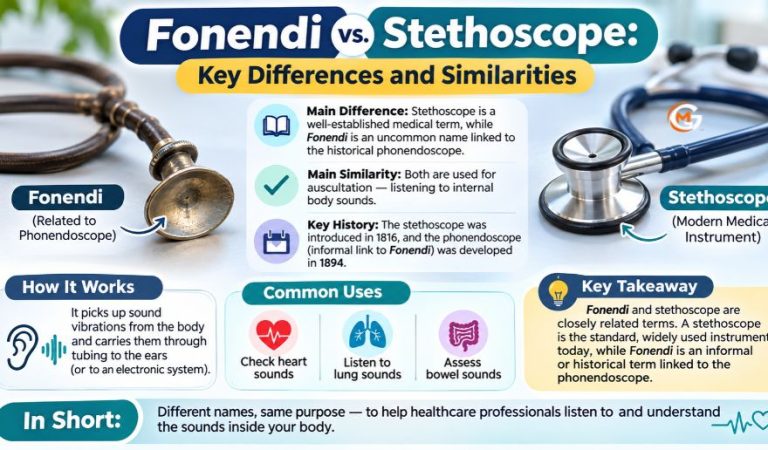
A stethoscope is one of the most familiar tools in healthcare. Doctors and nurses use it to listen to sounds made by the heart, lungs, and other parts of the body. Yet a less familiar name, Fonendi, sometimes appears in discussions about the same equipment.
The two names can make readers wonder whether they describe different instruments. The answer depends on language and history. Stethoscope is an established English medical term, while Fonendi has no clearly established meaning as a separate type of medical device.
Understanding the related word phonendoscope helps explain the confusion. This guide compares the terms, describes how medical listening tools work, and covers their practical uses, limitations, and care.
Quick Bio: Medical Instrument Facts
| Detail | Information |
|---|---|
| Term being compared | Fonendi |
| Established English name | Stethoscope |
| Related historical device | Phonendoscope |
| Related Spanish term | Fonendo |
| Full Spanish term | Fonendoscopio |
| Medical technique | Auscultation |
| First stethoscope | Introduced in 1816 |
| Early inventor | René Laennec |
| Phonendoscope introduced | 1894 |
| Phonendoscope developers | Eugenio Bazzi and Aurelio Bianchi |
| Common listening targets | Heart, lungs, abdomen |
| Acoustic power requirement | No battery |
| Modern device types | Acoustic and electronic |
| Core parts | Chestpiece, tubing, eartips |
What Is Fonendi?
Fonendi is not an established generic English name for a medical instrument. In healthcare-related writing, it is sometimes used informally in connection with the phonendoscope or stethoscope. However, its precise spelling and intended meaning are not standardized. The similar Spanish word fonendo is a documented short form of fonendoscopio, a term for a medical listening instrument. That connection helps explain why the names appear together, but it does not prove that Fonendi identifies a distinct device, brand, or advanced medical system. Context matters whenever the word appears on a website or product listing. The name also appears in unrelated business-oriented content, so a medical meaning should not be assumed in every setting.
What Is a Stethoscope?
A stethoscope is a medical instrument used for auscultation, which means listening to sounds produced inside the body. Its chestpiece rests against a patient’s skin, and the sound travels to the examiner’s ears. Healthcare workers commonly use it to assess breathing, heartbeat patterns, and certain abdominal sounds. A stethoscope can reveal clues, such as an unusual heart sound or wheezing, but it cannot establish a diagnosis on its own. The findings must be considered alongside symptoms, medical history, other examination results, and sometimes additional tests. The instrument helps with assessment; the listener’s judgment determines how its sounds are used.
Fonendi vs. Stethoscope: What Is Actually Different?
The main difference is the certainty of the terms. Stethoscope identifies a recognized category of medical instruments. Fonendi is an ambiguous spelling associated in some online material with similar devices, not a verified competing category with its own technical specifications. A phonendoscope, by contrast, has a documented history as a particular stethoscope design. Both historical phonendoscopes and modern stethoscopes were made to help people hear internal body sounds. In everyday U.S. and UK healthcare, stethoscope is the familiar term; wording may differ elsewhere. They share the basic purpose of supporting clinical examinations. Neither the name Fonendi nor the older phonendoscope label guarantees digital recording, stronger amplification, or better diagnostic accuracy. Any such claim needs evidence about a specific model.
A Brief History of the Phonendoscope
French physician René Laennec introduced the early stethoscope in 1816. It began as a simple listening tube rather than the flexible instrument familiar today. In 1894, Eugenio Bazzi and Aurelio Bianchi introduced the phonendoscope, a different design that used resonating components to make faint sounds easier to hear. Its creators promoted its sensitivity, although claims of superiority were disputed. Later developments brought binaural earpieces, improved chestpieces, and modern acoustic designs. The phonendoscope is therefore part of stethoscope history, not evidence that today’s Fonendi is a separate medical technology.
How Do Stethoscopes Work?
An acoustic stethoscope picks up vibrations and sound waves at the chestpiece. These signals travel through an enclosed pathway in the tubing and reach the eartips. A conventional diaphragm is generally useful for higher-pitched sounds, including many breath sounds. A bell, when present, can help with lower-pitched sounds when applied gently. Some newer chestpieces adjust their response according to pressure. Despite the simple design, effective listening depends on room noise, instrument condition, placement, and the examiner’s experience. Electronic models instead convert sounds into electrical signals, which may then be amplified, filtered, or recorded.
Main Stethoscope Parts and Features
Mast Read: Veneajelu: Discover the Beauty of Finnish Lakes and Water Adventures
Most familiar acoustic models have a chestpiece, flexible tubing, metal ear tubes, and soft eartips. The chestpiece includes a diaphragm and sometimes a separate bell. Tubing carries sound while helping limit outside noise, and well-fitting eartips improve comfort and the listening seal. Some instruments are designed for adult examinations, while smaller chestpieces may suit children. An electronic stethoscope may include controls, batteries, and recording features, but these depend on the manufacturer. These are features of particular stethoscopes, not established features of a product category called Fonendi.
Common Medical Uses
Clinicians listen to heart sounds to assess rhythm and notice possible murmurs. During lung examinations, they listen for air movement and sounds such as wheezes or crackles. A stethoscope may also help assess bowel activity and, with an appropriate cuff, support manual blood pressure measurement. These tasks require knowing where to listen and what normal findings sound like. Changes in sound may suggest that more assessment is needed, but many conditions cannot be confirmed by listening alone. Equally important, a normal-sounding examination does not rule out every medical problem.
How to Use a Stethoscope Correctly
Good technique begins before the chestpiece touches the patient. A quiet space, correctly angled eartips, and direct contact with the skin can improve sound quality. The examiner selects the appropriate listening surface and positions it over the area being assessed. Light or firm pressure may affect what is heard, depending on the chestpiece design. For a basic equipment check, follow this short sequence:
- Inspect the tubing and eartips for damage.
- Fit the eartips comfortably and check the listening side.
- Place the chestpiece gently against exposed skin.
- Clean the device after patient contact.
Recognizing abnormal findings safely requires clinical training.
Benefits and Limitations of Acoustic and Digital Models
Acoustic stethoscopes are portable, relatively simple, and ready to use without charging. They often suit routine examinations and student practice, although sound quality varies by instrument and technique. Digital models may provide amplification, selected noise filtering, or audio recording, which can help with review and some remote consultations. However, they may cost more and depend on batteries, software, or compatible devices. Neither type is automatically more accurate in every setting. Recordings may include personal health information, so clinicians should obtain appropriate consent and follow privacy and workplace rules.
Common Problems and Simple Maintenance
Weak sound does not always mean the instrument is defective. Poor eartip alignment, a loose diaphragm, damaged tubing, heavy clothing, or nearby noise can interfere with listening. First check the fit, make sure the intended chestpiece side is active, and inspect for wear. If sound remains unclear, follow the manufacturer’s troubleshooting advice or replace damaged parts. Stethoscopes touch multiple patients and can carry contamination. Clean and disinfect shared equipment between patients with a product suitable for that device. Avoid soaking the instrument or using harsh chemicals unless its instructions specifically allow them.
Choosing a Stethoscope and Considering Alternatives
The right choice depends on the work being done, not on which name sounds more advanced. Students may prioritize a comfortable fit, clear acoustics, and durable tubing. Clinicians in noisy settings may consider selected electronic features, while pediatric examinations can benefit from appropriately sized chestpieces. Check warranty terms, replacement parts, cleaning instructions, and whether software is required. An expensive instrument may still be uncomfortable or unsuitable if the eartips fit poorly or the chestpiece is the wrong size. Electronic auscultation systems and ultrasound can provide different forms of clinical information, but they are not interchangeable substitutes for every routine examination. If a listing calls a device Fonendi, verify the actual manufacturer and specifications before buying.
Final Thoughts
Fonendi and stethoscope should not be presented as two established competing medical device categories. Stethoscope is the standard English term, while Fonendi is an uncertain label sometimes connected with related terminology. The documented phonendoscope belongs to the instrument’s history. For everyday medical use, the important questions are how a specific stethoscope performs, whether it suits the examination, and whether its user has the training to interpret sounds properly.
FAQs
What does Fonendi mean in medical terminology?
Fonendi has no widely established definition as a formal English medical term. In some online contexts, it appears to refer to a phonendoscope or stethoscope. The related Spanish word fonendo is a recognized short form of fonendoscopio.
Is Fonendi the same as a stethoscope?
Someone using Fonendi in a medical discussion may mean a stethoscope, but the words are not equally precise. Stethoscope is the recognized instrument name. Check context rather than assuming Fonendi represents a separate model or product family.
What is the difference between a phonendoscope and a stethoscope?
Stethoscope is the broad instrument category. The phonendoscope was a historical variation introduced with a distinct resonating design. In some languages, related words are also used more generally for instruments that listen to internal body sounds.
Who invented the phonendoscope?
Eugenio Bazzi and Aurelio Bianchi introduced the phonendoscope in 1894. Their design used resonating parts intended to improve the audibility of body sounds. It appeared decades after Laennec’s early stethoscope of 1816.
How does a stethoscope detect heart and lung sounds?
A chestpiece receives vibrations from the body, and an acoustic model carries them through its tubing to the examiner’s ears. Electronic versions may process the signals. Proper placement and a quiet environment help the examiner hear important details.
Are digital stethoscopes better than traditional ones?
Not in every situation. Digital models can offer amplification or recording, but they may need charging and cost more. Traditional acoustic models remain useful for routine examinations. The better option depends on clinical needs, performance, and user skill.
Can someone use a stethoscope without medical training?
Anyone can learn to handle the instrument, but identifying a sound is different from understanding its medical meaning. Untrained listening cannot reliably confirm or rule out disease. Seek professional medical advice for symptoms or concerning findings.
Is Fonendi a recognized medical device brand?
The word Fonendi alone does not establish a verified medical manufacturer or a standardized device line. Similar names may be used in unrelated contexts. For any product, confirm the seller, maker, intended use, and applicable regulatory information before purchase.
For More News and Daily Updates Visit: Gigly Magazine
