

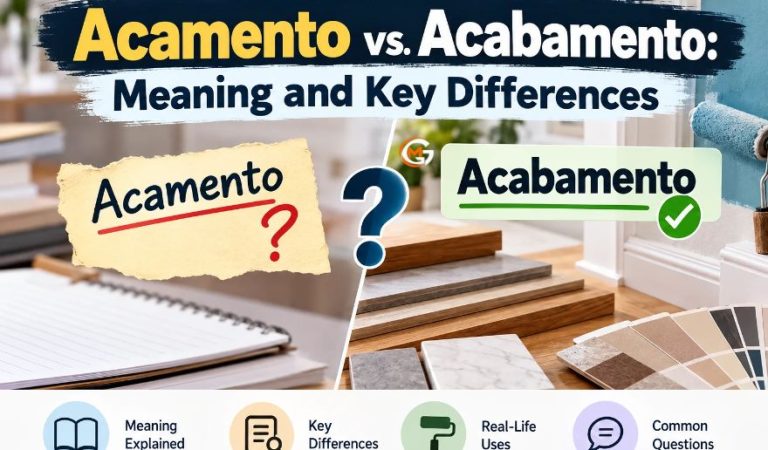
Acamento and acabamento look so similar that it is easy to assume they mean the same thing. Both spellings appear in online discussions about finishing work, design, and the final details of a product. Yet a small difference in spelling can make a big difference in accuracy.
Acabamento is an established Portuguese word for a finish, finishing work, or the act of bringing something to completion. Acamento, by contrast, does not have a widely established definition in standard Portuguese or English dictionaries. Its meaning depends on where it appears.
If you have seen Acamento in a product description, renovation guide, or translated document, this guide will help you interpret it. It explains the correct Portuguese term, where it is used, and how to avoid common translation mistakes.
Acamento and Acabamento at a Glance
| Detail | Information |
|---|---|
| Main term examined | Acamento |
| Established related word | Acabamento |
| Language of acabamento | Portuguese |
| Word class | Masculine noun |
| Basic English meaning | Finish or finishing |
| Other possible meanings | Completion; final treatment |
| Portuguese root | Acabar, meaning “to finish” |
| Word ending | -mento |
| Singular form | Acabamento |
| Plural form | Acabamentos |
| Acamento dictionary status | Not widely established |
| Typical professional fields | Construction; manufacturing |
| Other common contexts | Furniture; printing; textiles |
| Best translation approach | Check the full context |
What Does Acamento Mean?
Acamento has no single verified meaning that can safely be applied to every sentence. Some online articles use it when describing polishing, sanding, coatings, or final improvements. In those cases, the writer may be referring to acabamento. However, seeing the term used on a website does not prove that it is a standard word or an accepted industry label. It is better to treat its meaning as uncertain until the surrounding text gives a clear clue.
The spelling could be a typing error, an invented name, or an informal variation. It could also appear as part of a company name or a label chosen by its owner. These possibilities cannot be settled from the word alone. If you encounter Acamento in a contract, product listing, or technical instruction, identify its intended meaning before translating or correcting it. That matters more than guessing at a definition based on similar-looking words.
What Is Acabamento in Portuguese?
Acabamento is a recognized Portuguese masculine noun. It comes from acabar, a verb meaning to finish or bring something to an end, together with the noun-forming ending -mento. In everyday speech, acabamento can describe the final part of a task. In a workshop or construction setting, it often refers to the work that gives an object or space its finished appearance. The word may describe both the process and the result, depending on the sentence.
Its English equivalent is not always identical. A furniture maker may call a smooth varnished surface a finish. A builder may use finishing work for the final stage of a room. When judging the care put into making something, workmanship may fit better. Translating the word by context helps preserve what the writer actually means rather than using one English expression for every situation.
Acamento vs. Acabamento: The Main Differences
The clearest difference is recognition. Acabamento has an established spelling, meaning, and grammatical role in Portuguese. Acamento does not have an equally well-documented standard meaning. This does not prove that every use of Acamento is a mistake, but it does mean the two words should not automatically be treated as synonyms. If a Portuguese document discusses a surface finish, acabamento is normally the appropriate choice.
There is also a difference in reliability. Readers can interpret acabamento from the sentence and its recognized definitions. With Acamento, readers must first determine what the author intended. In formal writing, that extra uncertainty can create confusion over materials, work stages, and quality standards. When accuracy matters, a clear word such as acabamento, finish, or finishing is more useful than an unexplained variation.
Mast Read: Kaaaaaaadrizzle and Social Media: How People Use This Unique Expression
Why Do People Confuse These Spellings?
The words share much of the same visual pattern, making a missed pair of letters easy to overlook. Automatic spelling changes, hurried typing, and copied online descriptions can spread an unfamiliar form. Translation adds another problem: someone may see Acamento near pictures of painted walls or polished furniture and assume it is an official name for all finishing methods. That conclusion goes beyond the evidence. Check the original language, the type of work being described, and whether the same document uses acabamento elsewhere.
Where Is Acabamento Used in Real Life?
Construction and Interior Design
In building work, acabamento can cover the final visible elements of a space, such as paint, wall coverings, trim, flooring, and decorative details. For example, a renovation plan may describe materiais de acabamento, meaning finishing materials. These choices affect appearance, cleaning, durability, and the feel of a room. They are not just decorative extras: a suitable floor surface or correctly applied coating may also support everyday use and maintenance.
Furniture and Manufacturing
On furniture, acabamento may refer to staining, varnishing, painting, polishing, or the look of the completed surface. A matte finish scatters light differently from a glossy one. Metal products may have brushed or polished surfaces, while wooden objects may need protective coatings. The best finish depends on the material, expected wear, and desired appearance. A high shine is not automatically better than a low-sheen surface; each can be right for a different purpose.
Printing, Paper, and Textiles
In printing, acabamento can describe operations that turn printed sheets into a finished item, including trimming, folding, or binding. In paper production, it may refer to final surface treatment. Textile work can also include finishing processes that change a fabric’s feel or appearance. These uses show why context matters. The word does not name a single machine, coating, or universal technique. It describes different finishing tasks across several trades.
How Does Finishing Work Usually Happen?
Although the steps change by industry, finishing often starts with preparing a surface or material. Workers may clean away dust, smooth rough areas, repair visible flaws, or check dimensions. They then carry out the appropriate treatment, which could be paint, polish, sealant, trimming, or another final operation. A last inspection checks the appearance and whether the product meets its intended requirements. Some finishes improve wear resistance or ease of cleaning, but not all treatments offer the same protection. Material compatibility, instructions, and proper application remain important.
How to Use Acabamento Correctly in Sentences
Portuguese examples make the meaning easier to understand. O acabamento da mesa é liso means “The table has a smooth finish.” A casa está na fase de acabamento means “The house is in the finishing stage.” O produto tem bom acabamento may be translated as “The product has a good finish” or, in some situations, “The product shows good workmanship.” Each sentence uses the established spelling, while the best English wording changes with the subject.
For an English-language audience, choose finish when describing a surface or completed appearance, finishing for the process, and final touches for small details added near the end. In professional specifications, be more exact: name the material, coating type, color, texture, or performance requirement. Simply writing “good finishing” may be too vague for someone who needs to buy supplies or inspect completed work.
Similar Portuguese Words That Are Not the Same
Several related-looking words deserve attention. Acabado usually means finished or complete, whereas acabar is the verb to finish. Finalização can express completion or the act of finalizing something. Acamamento, despite its similar spelling, has different meanings, including layering or a prolonged state of being confined to bed. It should not be substituted for acabamento. Even a familiar-looking word can lead to the wrong translation if the surrounding topic is ignored.
How to Choose the Right Word in Your Writing
Start with the setting. If a Portuguese supplier is describing a cabinet’s surface, acabamento is likely the word you need. If an English writer is describing the final stage of a renovation, “finishing work” will usually be clearer. If Acamento appears as a product name or a heading, do not change it without checking whether it is deliberately named that way. Proper names and ordinary vocabulary follow different rules.
For practical documents, ask what the reader needs to do next. A buyer may need to compare glossy and matte finishes. A contractor may need a list of materials and acceptable surface quality. A translator may need to distinguish a finished result from the process of completing it. Choosing a precise phrase makes instructions easier to follow and reduces the risk of misunderstandings. No single spelling can replace clear technical details.
Final Thoughts
Acamento and acabamento should not be treated as interchangeable standard words. Acabamento has a recognized place in Portuguese and commonly refers to finishing, a finish, or final treatment. Acamento remains uncertain without context and may be an error, a chosen name, or an informal online form. For articles, translations, product descriptions, and professional work, use established terminology and explain any unfamiliar label. Checking the intended meaning can prevent a much larger misunderstanding.
FAQs
1. What Does Acamento Mean?
Acamento has no widely established standard definition. In some online discussions, it appears near descriptions of finishing work, but that alone does not make it a recognized technical term. Read the surrounding sentence before deciding what it means.
2. Is Acamento a Real Portuguese Word?
It is not established as an ordinary Portuguese word in the major dictionaries checked. That does not rule out use as a name or an invented expression. For standard Portuguese writing, choose a documented word that fits the meaning.
3. Is Acamento a Misspelling of Acabamento?
It may be, especially when the subject is construction, furniture, or surface finishing. Still, you should not correct every occurrence automatically. If it appears on packaging or in a business name, it could be intentional.
4. What Does Acabamento Mean in English?
Common translations include “finish,” “finishing,” “final treatment,” and sometimes “workmanship.” The best option depends on the sentence. For a wooden table, “finish” usually works; for the last stage of building work, “finishing” may be clearer.
5. How Do You Pronounce Acabamento?
The word is commonly divided into syllables as a-ca-ba-men-to, with the main stress on men. Pronunciation differs slightly between Brazilian and European Portuguese. Listening to a native speaker is helpful when learning its natural rhythm.
6. Is Acabamento Used in Construction and Design?
Yes. Portuguese speakers use acabamento for finishing work and finished surfaces in settings such as renovations, furniture, and interiors. It can describe paint, flooring, decorative details, surface treatments, or the quality of the completed result.
7. What Is the Difference Between Acabamento and Acamamento?
Acabamento relates to finishing or completion. Acamamento is a different Portuguese noun that can refer to layering or being confined to bed for an extended period. Their similar spelling does not mean they have similar uses.
8. Should I Write Acamento or Acabamento?
Use acabamento when writing standard Portuguese about finishing. In English, use “finish” or “finishing” when that communicates the idea more clearly. Keep Acamento only when it is an intentional proper name or a term explicitly defined by its source.
For More News and Daily Updates Visit: Gigly Magazine
