

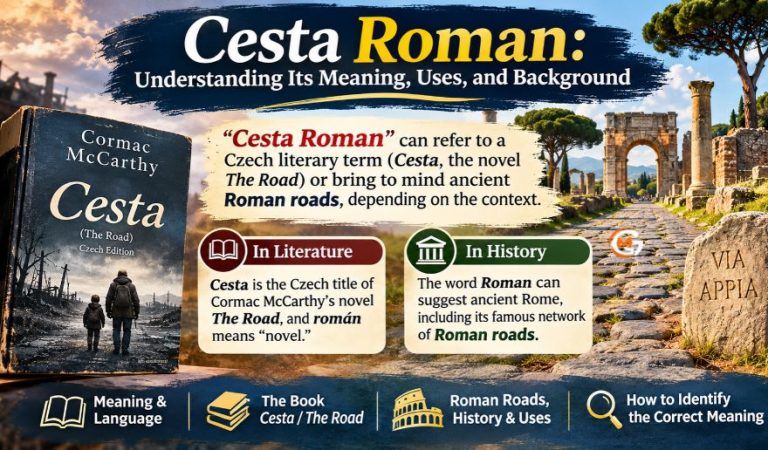
The phrase Cesta Roman can look like the name of an ancient route, a historical tradition, or a book. Its meaning depends on language, spelling, and context.
In Czech, cesta can mean a road, path, or journey. The Czech word román means a novel. That connection is especially useful because Cesta is also the Czech title of Cormac McCarthy’s acclaimed novel The Road.
This guide separates facts from interpretations, explaining the language, the book, and the unrelated history of Roman roads.
Quick info: Cesta Roman at a Glance
| Detail | Information |
|---|---|
| Main expression | Cesta Roman |
| Fixed English definition | Not established |
| Language connection | Primarily Czech |
| Meaning of cesta | Road, path, journey |
| Correct Czech word for novel | Román |
| Meaning of English Roman | Relating to Rome |
| Confirmed book title | Cesta |
| Original English title | The Road |
| Book author | Cormac McCarthy |
| Original publication | 2006 |
| Czech publisher | Argo |
| Early Czech edition | 2008 |
| Czech translator | Jiří Hrubý |
| Major literary award | 2007 Pulitzer Prize |
| Roman-road connection | Separate historical topic |
What Does Cesta Roman Mean?
Cesta Roman does not have one widely established meaning in English. It may bring together a Czech word for a journey and an unaccented form of the Czech word for novel. Someone browsing translated book listings could read it as a reference to Cesta, the novel. Someone reading only the English word Roman might instead think of roads built by ancient Rome. Neither interpretation makes the two words an official historical name. Identify the language and subject before choosing an interpretation.
Understanding the Words Cesta and Román
The Meaning of Cesta
In Czech, cesta describes more than a paved road. It can refer to a path through the countryside, a route between places, or the experience of taking a trip. Its exact English translation changes with the sentence. A person asking for directions may mean the way to a destination, while a traveler talking about a long cesta may mean the journey itself. In book titles, journeys can suggest emotional change as well as travel.
Why the Accent in Román Matters
The Czech noun román, written with an accent over the a, means a novel. Without that mark, roman may be a simplified spelling entered on a keyboard, but it is not the standard Czech spelling of the noun. In English, Roman usually describes someone or something connected with Rome. French also uses roman for novel, without an accent. These overlapping forms explain confusion without establishing a formal phrase.
Why the Phrase Appears in Literature Discussions
Book catalogs and publisher descriptions often combine a work’s title with its genre. In Czech, a listing might describe Cesta as a román, simply saying that Cesta is a novel. When accents disappear, word order changes, or text is copied into English-language pages, the words can appear together as Cesta Roman. That does not necessarily identify another book with that exact title. Check the author, original title, and publisher rather than two isolated words.
Cesta: The Czech Edition of The Road
Publication and Translation
Cormac McCarthy published The Road in English in 2006. The Czech publisher Argo released Cesta in 2008, with a translation by Jiří Hrubý. This establishes a clear and documented literary use of the word Cesta. The novel won the Pulitzer Prize for Fiction in 2007. For U.S. and U.K. readers, The Road by McCarthy is the clearest title to use.
What Happens in the Story?
The novel follows an unnamed father and his young son traveling through an America devastated by an unspecified catastrophe. They move toward the coast, searching for food and somewhere safer to live. Ash, cold weather, abandoned buildings, and threats from other survivors shape their journey. The father wants to protect his child, while the boy continues to question what kindness means in a brutal world. The disaster remains unexplained; their relationship and choices drive the story. A film adaptation exists, but it should not be confused with the Czech book edition or its translation credits.
Major Themes and Writing Features
Survival, Trust, and Family
At its center, The Road is a story about care under extreme pressure. The father must judge whom to trust and when to avoid danger, often without enough information. The son challenges choices that seem necessary for survival but difficult to defend morally. Their bond creates tension as well as comfort. Readers may see the journey as a test of responsibility, compassion, and hope, rather than an adventure built around discovering the cause of the catastrophe.
The Road as a Symbol
McCarthy’s spare sentences and limited dialogue create a tense, stripped-down atmosphere. The landscape offers few familiar signs of ordinary life, so small acts of help or tenderness carry unusual weight. The road is both a physical route and a symbol of moving forward without certainty. Because the novel leaves some questions unanswered, readers have room to develop different interpretations. Its emotional force comes from the characters’ fears, sacrifices, and values.
Why Some Readers Think of Ancient Roman Roads
Mast Read: Fonendi vs. Stethoscope: Key Differences and Similarities
The second interpretation comes from reading Roman as the English adjective connected with ancient Rome. The Romans built an extensive system of roads across their territories, and the word cesta can mean road in Czech. Combining those ideas might suggest a Roman road or journey. However, Cesta Roman is not the recognized name of the ancient road network, and it should not be presented as a Latin technical term. Historical texts instead identify particular routes by established names, often beginning with the Latin word Via. English grammar offers another clue: historians normally say “Roman road,” not “road Roman.” Reversed wording is a reason to check whether a phrase has been translated or copied incorrectly.
Roman Roads: Their History and Practical Uses
Travel, Trade, and Military Movement
Roman roads helped armies move between settlements and frontier regions, but they also supported merchants, messengers, and administrators. Their routes connected towns, ports, and important provincial centers. The Appian Way, known in Latin as Via Appia, began in 312 BCE and became one of the best-known roads leading out of Rome. The network helped Rome govern distant territories around the Mediterranean.
Construction and Surviving Remains
Roman engineers paid attention to foundations, drainage, and the surrounding terrain. Some roads had compacted layers beneath a durable surface, while others used materials suited to local conditions. They were often strikingly direct, although routes still responded to hills, rivers, and other obstacles. Sections of ancient roads remain visible, and later paths sometimes follow their courses. Research a road by its historical name and location, not this expression.
How to Find the Correct Meaning in Context
The quickest method is to inspect the words nearby. A page mentioning McCarthy, Argo, a Czech edition, or a father and son crossing a ruined landscape is almost certainly discussing the novel. A passage mentioning Via Appia, legions, archaeology, or road-building belongs to ancient history. For language questions, check whether román carries its accent and whether the sentence is Czech, French, or English. You can also compare the title, author, publication year, and translator in a book catalog. These details are more reliable than a vague heading on its own. If you plan to buy the book, verify the language, ISBN, and edition before ordering. Cover artwork alone may change between publishers and years.
Common Misunderstandings to Avoid
A common mistake is translating every occurrence of cesta as a paved road. Sometimes it means a trip or a route in a broader sense. Another is assuming that Roman must refer to ancient Rome, even when a book description plainly uses the Czech word román. Do not call Cesta Roman a documented Roman highway, ancient philosophy, or McCarthy’s original title. None of those claims follows from the words alone. Context, correct spelling, and publication details matter more than an appealing story about the phrase.
Final Thoughts
Cesta Roman is best understood as an expression whose interpretation depends on language and context, not as a term with one fixed definition. The clearest documented connection is literary: Cesta is the Czech title of Cormac McCarthy’s The Road, and román means novel. Ancient Roman roads offer a different topic prompted by the English word Roman. Keeping those subjects separate makes it easier to identify books, understand translations, and avoid inaccurate historical claims.
FAQs
1. What does Cesta Roman mean?
It has no single confirmed meaning as a fixed English expression. In a Czech literary setting, it may point to Cesta, meaning The Road, alongside román, the word for novel. In an English historical setting, Roman might suggest ancient Rome. Context is essential.
2. Is Cesta Roman a Latin phrase?
There is no good basis for presenting the entire expression as an established Latin term. Cesta is familiar in modern Slavic languages, including Czech, while historical Roman roads are commonly identified with Latin names such as Via Appia.
3. What does cesta mean in English?
The Czech word cesta can mean road, path, way, route, journey, or trip. In travel it may describe a route; in literature, a personal journey.
4. Why does román sometimes appear without an accent?
People sometimes omit accents when typing or copying titles. The standard Czech spelling for novel is román. The unaccented French word roman also means novel, so identifying the language helps.
5. Is Cesta the same book as The Road?
Yes. Cesta is the Czech title used for Cormac McCarthy’s novel The Road. Argo published a Czech edition in 2008 translated by Jiří Hrubý. It is a translation, not a sequel.
6. What is the novel Cesta about?
It follows a father and son traveling through a devastated America after an unexplained disaster. They face hunger, cold, and danger while trying to reach the coast. The story explores protection, moral choices, trust, and the possibility of hope.
7. Was Cesta Roman an ancient Roman road?
No specific ancient road is established by that name. The Roman road system was real, but its major routes are known by names such as the Appian Way and Via Flaminia. The phrase is not a documented historical designation.
8. How can I check which interpretation is correct?
Start with the surrounding names and details. McCarthy, The Road, Czech publishing, and the word román indicate literature. Latin route names, ruins, archaeology, and Roman engineering point to history. A dictionary or publisher catalog can help confirm it.
For More News and Daily Updates Visit: Gigly Magazine
