

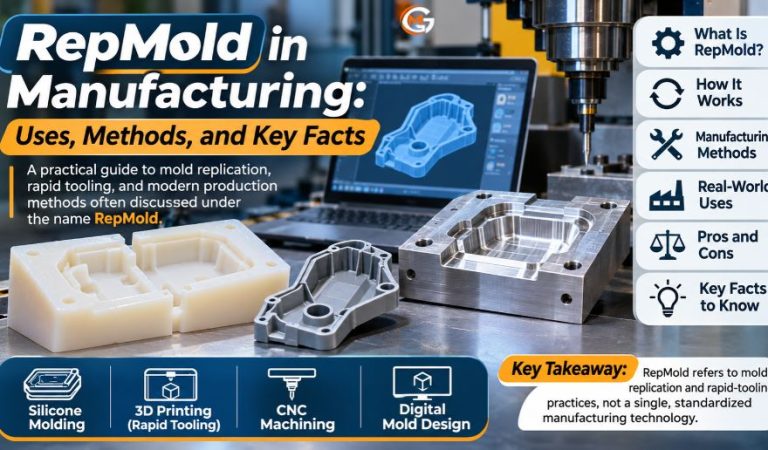
Manufacturers often need to reproduce a part, replace an old mold, or test a new design before starting full production. Online discussions sometimes use the name RepMold for work that combines mold replication with digital design and modern production tools.
However, RepMold is not a clearly defined industrial process with an established set of technical standards. Methods linked to the term, including rapid tooling, 3D scanning, CNC machining, and resin casting, are real and widely used.
Understanding those methods is more useful than relying on a broad label. This guide explains how mold replication works, where it helps, what equipment is required, and which practical limits manufacturers should consider.
RepMold Quick Bio
| Detail | Information |
|---|---|
| Name | RepMold |
| Context | Manufacturing-related online discussions |
| Technical definition | No widely established single definition |
| Closely related field | Mold replication and rapid tooling |
| Typical starting point | CAD model or physical master |
| Digital design tool | Computer-aided design (CAD) |
| Measurement method | 3D scanning or manual inspection |
| Tool-making options | CNC machining or 3D printing |
| Common soft mold | Silicone rubber |
| Example casting materials | Polyurethane or epoxy resin |
| Suitable project types | Prototypes and limited production |
| Main selection factors | Accuracy, material, volume, and cost |
| Common quality checks | Dimensions and surface finish |
| Main caution | Verify the specific process being offered |
What Is RepMold in Manufacturing?
RepMold appears in online descriptions of mold copying, rapid tooling, and digital manufacturing. Yet the name does not identify one verified machine, patented workflow, or formally standardized production method. Some descriptions focus on scanning and rebuilding old tools. Others discuss creating new molds for short production runs. These are different activities, even when they share equipment.
The useful starting point is the meaning of mold replication. A manufacturer makes a mold from an existing pattern or design, then uses that mold to produce parts with a matching shape. In other cases, engineers recreate the mold itself from measurements. A supplier using the RepMold label should explain the exact technique, materials, achievable tolerances, and inspection plan rather than relying on the name alone.
How Does Mold Replication Work?
Most projects begin with a CAD file, technical drawing, or physical example. If only an existing part is available, engineers can measure or scan it and rebuild its shape in CAD. They check worn areas, account for expected material shrinkage, and add features needed to release the finished part. A master pattern or mold can then be machined or printed. For silicone casting, liquid silicone is formed around the master and cured. The master is removed, resin is poured or injected into the cavity, and the casting is allowed to harden before inspection. Actual steps change with the chosen method, so there is no universal RepMold workflow.
Main Mold-Making Methods Connected With RepMold
Silicone Molding and Vacuum Casting
Silicone molds can reproduce fine surface details and are useful when only a limited number of plastic-like parts is needed. A master pattern is placed inside a mold box, covered with silicone, and removed after curing. A suitable casting resin fills the resulting cavity. Vacuum equipment may help reduce trapped air, depending on the process. Silicone tools are flexible, but they wear out and may change shape with repeated use.
3D Printing and Rapid Tooling
3D printing builds a pattern, mold, or mold insert from digital data. It can reduce the effort needed to test new shapes, especially when a design changes several times. Printed tooling is not always ready for use straight off the machine. Cleaning, curing, sanding, coating, or dimensional checks may be needed. Heat resistance, pressure, and tool life depend heavily on the printing material and molding conditions.
CNC Machining and Reverse Engineering
CNC machines cut a programmed shape into metal, plastic, or another suitable stock material. Aluminum tools can be practical for some shorter runs, while carefully designed steel molds are often chosen for demanding, repeated production. Reverse engineering may support either approach: engineers measure an old part, create corrected CAD data, and machine replacement tooling. A scan captures visible geometry, but it cannot automatically reveal hidden features or original material properties.
Materials, Equipment, and Design Requirements
The right setup depends on the job. Common tools include CAD software, measuring instruments, 3D scanners, printers, CNC machines, mixing equipment, and curing systems. Silicone rubber is often used for flexible molds, while polyurethane and epoxy resins can produce cast parts. Metal tooling supports processes involving greater heat, pressure, or repeated cycles. Designers must also plan draft angles, parting lines, vents, wall thickness, and shrinkage allowances. Before production, confirm that the mold and casting materials are compatible and that the equipment can meet the required dimensions.
Mast Read: Thealitekeepsafe.com: A Helpful Guide to Online Safety and Privacy
Where Are Mold Replication Methods Used?
Prototypes and Small Production Runs
Product teams use rapid tooling to test how a housing, handle, cover, or assembly fits before paying for long-life production molds. Limited batches can also serve customer trials and functional testing. Automotive suppliers, electronics businesses, and consumer-product makers use these established techniques, although that does not mean they use a distinct RepMold system. The method must match the part’s load, temperature, and finish requirements.
Replacement Parts and Older Designs
Reverse engineering is valuable when an original drawing is missing or a spare part is no longer sold. Engineers can measure an existing example, repair damaged geometry in the digital model, and make a replacement through casting, machining, or printing. They must identify the correct material and check critical dimensions. Copying a worn component without correcting its defects may simply reproduce the original problem.
How to Choose a Suitable Production Method
Begin with the number of parts needed, the operating conditions, and the dimensional tolerance. Then consider the desired surface finish, expected changes to the design, and delivery deadline. For a few trial pieces, printing or silicone casting may be sensible. For thousands of consistent parts, conventional production tooling may offer a lower cost per unit despite higher initial spending. Ask suppliers for sample parts, material data, tool-life estimates, inspection records, and a full quotation that includes finishing and rejected parts. Comparing total project cost is more reliable than comparing mold prices alone.
Benefits and Limitations of Rapid Tooling
Rapid tooling can shorten early design cycles and avoid large upfront investments when a project needs only a small batch. Digital files are easier to revise than an already completed steel tool, and casting may provide useful material properties for functional testing. The trade-offs matter just as much. Soft molds have limited service lives, printed tools may not tolerate high processing temperatures, and cast parts can vary with curing conditions. Setup, inspection, and failed attempts also add cost. No technique is automatically faster, cheaper, or more accurate for every part.
Common Mold-Making Problems and Practical Fixes
Air bubbles, incomplete filling, surface marks, dimensional changes, and damaged molds can reduce part quality. Trapped air may require better venting, careful mixing, or suitable vacuum processing. Short fills can result from resin viscosity, poor flow paths, or insufficient working time. Distortion may point to uneven curing, weak tool support, or shrinkage that was not included in the design. Mold wear calls for checking release methods and the tool material. Test a small batch, record the defects, and adjust one likely cause at a time before expanding production.
Alternatives to RepMold-Style Workflows
Traditional injection molding is suitable for many high-volume plastic products when the cost of durable tooling can be spread across a large number of parts. Direct CNC machining can make finished components without creating a separate casting mold, particularly for metal parts or projects with strict material requirements. Direct 3D printing may work better for highly customized shapes or very small quantities. Each option has different costs, material choices, design limits, and finishing needs. Choose an established process based on evidence rather than a broad manufacturing label.
Quality, Safety, and Design Ownership
A finished part should be checked against its drawing, not just compared by eye with a master. Critical measurements, surface condition, and material performance may need documented testing. Resin handling also requires care: some polyurethane systems contain isocyanates, which can harm health if exposure is not controlled. Follow the product safety data sheet, use suitable ventilation and protective equipment, and train operators. When copying parts or molds, confirm ownership, licensing rights, and any applicable product safety obligations before manufacturing replacements.
Final Thoughts
RepMold is best treated as an unclear label associated with real mold-replication and rapid-tooling practices, not as proof of a separate industrial technology. Silicone casting, 3D printing, CNC machining, and reverse engineering each solve different problems. The sound approach is to define the required part, select a documented manufacturing process, test its results, and check costs and quality before committing to production.
(FAQs)
What does RepMold mean in manufacturing?
RepMold is used in some online discussions about mold replication and digital tooling. It does not have one widely established industrial definition. Ask which actual manufacturing method a supplier means.
Is RepMold a recognized manufacturing technology?
The related methods are established, but RepMold itself is not clearly documented as a standardized process. Claims about special capabilities should be supported by technical specifications and tested examples.
How is a mold copied from an existing part?
A technician measures or scans the part, creates a usable model or master, and produces a mold using a suitable method. Test castings help confirm dimensions and surface quality.
Which materials are used in mold replication?
Common choices include silicone rubber for flexible molds, polyurethane or epoxy for cast pieces, and aluminum or steel for durable tooling. The intended process determines the right material.
Can RepMold be used for automotive parts?
Mold replication and rapid tooling can help develop automotive prototypes or replacement components. Safety-critical parts require proper material validation, engineering checks, and compliance with applicable requirements.
Is mold replication the same as 3D printing?
No. Printing can create a mold or its master pattern, but replication may also involve machining, silicone casting, or other methods. Some projects combine several techniques.
Is rapid tooling cheaper than traditional tooling?
It can cost less upfront for prototypes and small batches. Durable production tooling may be more economical when many identical parts are required. Compare the total cost per acceptable part.
What are the biggest limitations of mold replication?
Key limits include mold wear, material compatibility, dimensional variation, and slower output for some casting methods. Proper design, testing, and inspection help identify these limits before larger production runs.
For More News and Daily Updates Visit: Gigly Magazine
