

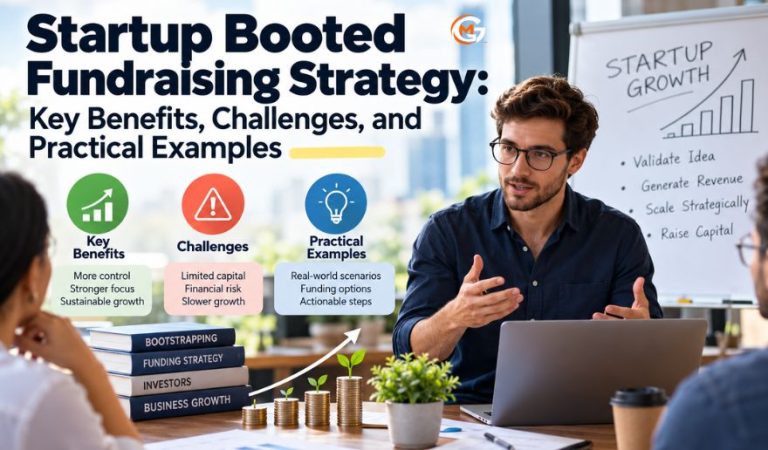
The Startup Booted Fundraising Strategy describes founder-led financing: start with personal resources and customer revenue, then seek outside capital for a clear purpose. StartupBooted also uses this phrase for its fundraising consulting service, so it has both a commercial and a broader meaning.
For founders, the distinction matters. A company needs enough cash to develop products without accepting terms that weaken ownership or create unsustainable growth pressure.
This guide explains the approach, the support StartupBooted advertises, the decisions founders must make, and practical examples of when selective fundraising may help—or create problems.
What Is Startup Booted Fundraising Strategy?
The central idea is to establish a working business before making outside investment its main source of funding. Founders may begin with savings, small operating budgets, and money earned from customers. They then assess whether additional capital would produce enough value to justify its cost.
Bootstrapping generally means growing without selling equity to investors. Selective fundraising builds on that discipline but permits grants, borrowing, revenue-based financing, or limited equity. It is not a standardized financing method with universal rules.
StartupBooted positions its strategy between self-funding and conventional venture capital. This positioning does not establish that the approach produces better terms for every company.
How the Revenue-First Approach Works
A founder starts by testing whether customers will pay for a useful product or service. Instead of immediately hiring a large team, the business may launch a smaller offer, gather feedback, and improve what customers actually buy. Early sales help establish demand, but revenue alone does not prove profitability.
The founder then tracks cash receipts, expenses, and remaining runway. Profits can be reinvested in product improvements, sales, or staffing, creating growth capital without selling shares.
Outside funding becomes an option when equipment, development, or distribution has a credible return. The decision rests on cash flow, risks, and terms—not an assumption that every startup needs venture capital.
What Fundraising Support Does StartupBooted Advertise?
StartupBooted presents fundraising strategy as consulting, not as direct investment. Its fundraising page advertises prices starting at $2,000, not a fixed total fee or a promise of investment.
Customized Fundraising Planning
The service describes planning around each startup’s objectives. A useful engagement should define a target amount, timing, intended uses, and potential financing routes. Founders should confirm written deliverables.
Investor Pitch Optimization
StartupBooted advertises pitch improvement. A useful presentation explains the customer problem, product, business model, traction, competition, and funding purpose. Design cannot replace accurate financial information.
Targeted Investor Outreach
The provider also advertises identifying and approaching suitable investors. Founders should confirm whether this means advice, a contact list, introductions, or direct outreach support. These are different services, and none ensures investment.
Data-Driven Fundraising Guidance
StartupBooted describes using data to help identify promising fundraising channels. A useful analysis should connect investor selection with business stage, sector, traction, and capital needs rather than promise results based on an undisclosed scoring method.
Separate pages advertise pitch deck design and financial modeling at higher starting prices. Before purchasing, check the current quote, revision limits, confidentiality arrangements, and whether additional services are billed separately.
Which Startups Are Suitable, and What Do They Need?
Revenue-first financing may fit software products, agencies, education services, and other businesses that can reach paying customers without enormous initial spending. It also suits founders who prefer independent decisions and measured expansion.
The fit is weaker when a company needs expensive laboratories, regulatory trials, manufacturing facilities, or years of development before sales are possible. Self-funding such projects can delay critical milestones.
Before using the approach, founders should have an identifiable customer problem, evidence of willingness to pay, a realistic cost estimate, and clear records of existing ownership. Even a simple forecast should show expected revenue, direct costs, fixed expenses, and available cash under an unfavorable scenario.
A minimum viable product—a limited version used to test demand—reduces uncertainty, although early customers do not automatically attract investors.
How to Build a Practical Fundraising Plan
Start with business needs, not an arbitrary fundraising target. Small teams can follow these steps without existing investor contacts.
Step 1: Validate Demand Before Scaling
Interview customers, test prices, and record purchases or credible commitments. Interest is not payment. More funding cannot solve an unproven demand problem.
Step 2: Calculate the Funding Gap
Estimate the next milestone’s costs, including salaries, development, taxes, and contingency. Subtract available cash and realistic receipts to identify the actual funding gap.
If six months’ spending is $90,000 and dependable resources cover $55,000, the initial gap is $35,000 before contingency. Cash timing also matters.
Step 3: Compare the Real Cost of Capital
Consider whether retained earnings, prepayments, grants, loans, or equity can meet that gap. A loan preserves shares but adds repayment pressure; equity may remove fixed repayments while reducing ownership and potentially granting investors decision rights.
Model at least a base case and a downside case. A funding arrangement that works only when sales meet an optimistic forecast leaves the company exposed.
Step 4: Prepare Materials and Approach the Right Funders
Prepare a pitch, forecast, ownership record, and customer evidence. Approach investors or lenders matching your stage, industry, and funding need. Track responses rather than counting emails sent.
Mast Read: Supermaked and Modern Grocery Shopping: Exploring the Retail Connection
Key Benefits of Founder-Led Funding
More Room to Make Independent Decisions
Self-funded companies can often choose their pace and priorities without negotiating with shareholders. That flexibility matters for niche businesses unsuited to venture-style growth.
Less Early Ownership Dilution
Delaying equity fundraising can preserve ownership while demand develops. Raising at a stronger valuation might mean selling fewer shares for the same capital, although waiting does not guarantee better terms.
Stronger Attention to Customers and Costs
Limited resources can encourage close attention to margins, retention, and spending. A business that learns to win paying customers may have stronger evidence to present to potential investors. That discipline is useful, provided cost-cutting does not undermine product quality or essential compliance.
Challenges and Risks Founders Should Consider
Cash Constraints Can Slow Progress
Without ample financing, a company may postpone important hires or product improvements. Competitors with more resources may enter a market faster. Slow growth is not inherently safer when timing or scale is central to success.
Personal Savings Are Exposed
Self-funding exposes founders’ savings, while personal loan guarantees increase risk. Set a contribution limit rather than continually covering losses without revising the plan.
Revenue Does Not Equal Available Cash
A startup can report sales while struggling to pay bills because customers settle invoices late or because inventory consumes cash. Founders need a cash forecast, not just a profit estimate. Tax obligations and irregular expenses also require reserves.
Selective Investment Still Changes the Deal
Minority investors may negotiate approval rights or special payout preferences. Convertible financing can dilute ownership later, even without immediate shares. Review terms professionally.
Funding Sources That Can Complement Bootstrapping
Customer Revenue and Advance Payments
Retained earnings are generally the least complicated funding source, although they may be insufficient for rapid expansion. Preorders, subscriptions, or customer deposits can help finance delivery, but the business must meet its obligations or handle refunds where required.
Grants, Loans, and Revenue-Based Financing
Some public or private programs provide grants for eligible projects, usually with application criteria and spending restrictions. Loans supply cash without selling shares but require repayment. Revenue-based financing typically collects payments linked to sales and can be expensive when total repayment obligations are high.
Angel Investors and Limited Equity Rounds
Angels may invest smaller amounts than institutional venture funds and sometimes provide useful industry connections. Equity financing can support investment before the company generates enough cash to repay debt, but it dilutes existing shareholders. The percentage sold is only one part of the negotiation; investor rights matter too.
Eligibility, taxes, and fundraising rules vary by country. Founders must check requirements for their company and chosen financing route.
When Does Raising Outside Capital Make Sense?
Outside capital helps when it removes a defined constraint at an acceptable cost. Examples include equipment for confirmed orders or engineers to serve signed customers.
Founders can test the decision with four questions: What milestone will the money achieve? How much cash is truly necessary? What happens if revenue falls short? And what ownership, repayment, or control commitments will the company accept?
Track cash runway, gross margin, repeat purchases, acquisition costs, and retention where relevant. These distinguish temporary funding needs from an unsound business model.
Three Practical Examples of Selective Fundraising
These hypothetical examples are not StartupBooted client cases or typical outcomes. They illustrate different financing choices.
Example 1: A Subscription Software Business
A two-person software company earns $8,000 a month from subscriptions and spends $6,000, leaving $2,000 before taxes and exceptional costs. It reinvests part of the surplus into customer support and improvements instead of raising equity immediately.
It might later raise money to hire an engineer. Waiting creates customer evidence but risks slower development or lost subscribers.
Example 2: A Service Agency Expanding Carefully
A design agency starts with $12,000 in founder savings and secures clients that pay monthly. After covering staff and operating costs, it generates $3,000 in monthly cash surplus. It builds a reserve before recruiting another specialist.
Losing one large client could erase its surplus. It might diversify customers before considering an affordable working-capital loan.
Example 3: A Product Company Seeking Targeted Capital
A small consumer-products company has repeat orders but needs $75,000 for tooling and inventory. Its available cash covers $30,000, leaving a $45,000 gap. The founders compare supplier terms, preorders, loans, and an angel investment.
An angel offering $45,000 for 10% of the company would imply a $450,000 post-investment equity valuation in a simple priced round, before considering fees or special rights. This illustrates dilution, not a recommended valuation. Compare alternatives before signing.
Common Fundraising Problems and Practical Fixes
Running Out of Working Capital
A timing gap between spending and receipts may be responsible. Forecast cash weekly, collect invoices, and reduce optional costs. Do not count unconfirmed investment as available cash.
Getting Little Interest From Investors
The opportunity may not match the investor’s mandate, or the evidence may be too weak. Check investor fit, improve the explanation of customer demand, and ask for specific feedback. More outreach alone cannot repair weak unit economics.
Asking for the Wrong Amount
Raising too much can increase dilution; too little can leave milestones unfinished. Match the amount to a costed plan and downside scenario.
Accepting Unfavorable Conditions
Founders sometimes focus on cash received while overlooking repayment schedules, liquidation preferences, guarantees, or approval rights. Review a full term sheet and model its effects under future funding and exit scenarios before signing.
Alternatives to a Selective Fundraising Approach
Fully Bootstrapped Growth
A founder can choose to avoid outside investors and expand only as profits allow. This approach keeps equity ownership concentrated but may limit hiring, product development, and speed. It requires a realistic path to positive cash flow.
Venture Capital Funding
Venture capital may suit companies pursuing large markets that need significant upfront investment and can plausibly deliver rapid growth. Investors typically expect substantial returns and may negotiate governance rights. It is not automatically appropriate for a profitable local business or a niche service provider.
Debt Financing or Business Loans
Loans can fund equipment, inventory, or predictable working-capital needs while avoiding equity dilution. The trade-off is interest, repayment schedules, and sometimes collateral or personal guarantees. Availability depends on lender criteria, trading history, and jurisdiction.
Final Thoughts
Startup Booted Fundraising Strategy combines the discipline of bootstrapping with the option to obtain outside capital when it serves a measurable business goal. StartupBooted markets consulting support around that idea, but buying advisory services does not remove the financial risks of fundraising or guarantee an investment.
The strongest starting point is a realistic cash plan supported by paying-customer evidence. Compare financing costs, protect essential reserves, and seek qualified advice before accepting binding investment or loan terms. A smaller, well-timed raise can be useful; so can deciding not to raise at all.
FAQs
Is Startup Booted Fundraising Strategy a Service or a General Approach?
It refers to both. StartupBooted markets a consulting service under that name, while the underlying concept describes using founder resources and early revenue before seeking selective outside financing. The approach is not a universally standardized funding product.
Does This Strategy Mean Avoiding Investors Completely?
No. The goal is to avoid unnecessary or poorly timed outside funding, not to prohibit investment. A founder may take an angel investment or another form of capital once it helps achieve a defined business milestone.
How Much Money Is Needed to Begin Bootstrapping?
There is no universal minimum. A service business might begin with modest equipment and marketing expenses, while a physical product business may require substantial development and inventory spending. Estimate startup costs and a realistic cash reserve first.
Can a Startup Raise Money Without Selling Equity?
Yes. Customer prepayments, some grants, and conventional loans can provide funds without issuing shares. However, borrowing involves repayment obligations, while grants and advances may carry conditions. Non-dilutive financing is not necessarily free money.
What Documents Should Founders Prepare Before Fundraising?
Common materials include a pitch deck, cash-flow forecast, financial statements where available, ownership records, and evidence of customer demand. Investors may also request contracts and a document repository for due diligence. Requirements vary by funding route.
When Is Venture Capital a Better Choice?
It may be more suitable when a company needs substantial capital before reaching revenue and has a credible path to rapid, large-scale growth. Consider ownership and governance terms carefully.
What Is the Biggest Risk of Using Personal Savings?
The founder may lose money needed for household expenses, emergencies, or retirement. Setting an affordable contribution limit and separating personal finances from business records helps keep that risk visible, although it cannot eliminate losses.
Does Hiring a Fundraising Consultant Guarantee Investment?
No. Consultants may improve planning and outreach, but investors and lenders decide whether to fund. Confirm scope, fees, delivery, confidentiality, and refunds before paying.
For More News and Daily Updates Visit: Gigly Magazine
