

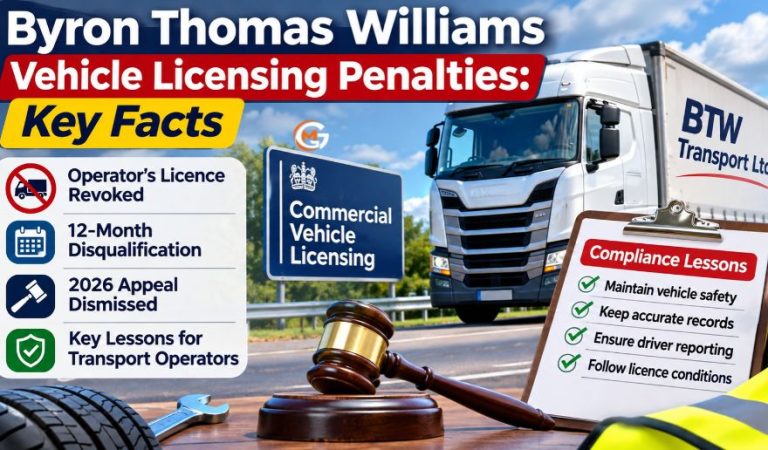
The Byron Thomas Williams Vehicle Licensing Penalties case concerns a UK road freight company, its sole director, and commercial vehicle safety failures. BTW Transport Ltd lost its goods vehicle operator’s licence following repeated compliance failures. The decision concerned business operating authority rather than an automatic ban on personal driving.
The case extended beyond vehicle tax. Investigators identified shortcomings in safety inspections, driver reporting, records, and the company’s response to regulatory warnings. Its most serious finding concerned operations after an earlier licence revocation.
In July 2026, the Upper Tribunal dismissed an appeal against the later penalties. The timeline explains the sanctions and what they mean for the company’s licensing status.
Quick info and Case Facts
| Detail | Information |
|---|---|
| Full name | Byron Thomas Williams |
| Known in decisions as | Byron Williams |
| Business role | Sole director |
| Company | BTW Transport Ltd |
| Industry | Road freight transport |
| Company incorporated | May 18, 2020 |
| UK company number | 12606765 |
| Operator licence | OB2034896 |
| Licence category | Standard national |
| Authorized fleet | 7 vehicles, 8 trailers |
| Regulatory area | North East England |
| Final public inquiries | July and September 2025 |
| Revocation effective | October 22, 2025 |
| Director’s disqualification | October 23, 2025–October 22, 2026 |
| Appeal result | Dismissed July 22, 2026 |
Who Is Byron Thomas Williams?
Byron Thomas Williams, also identified as Byron Williams in official decisions, was the sole director of BTW Transport Ltd during the proceedings. The company was incorporated in England in May 2020 and operated in road freight transport. Its standard national operator’s licence, granted in August 2020, authorized seven goods vehicles and eight trailers. The public case concerns his business responsibilities, not his private life.
How Commercial Vehicle Licensing Works in the UK
An operator’s licence allows an eligible business to use certain goods vehicles commercially, under legal conditions. A standard national licence generally requires a professionally competent transport manager, adequate financial standing, good repute, and arrangements to keep vehicles roadworthy. The Traffic Commissioners oversee licensing, while the Driver and Vehicle Standards Agency (DVSA) checks compliance. An operator’s licence differs from a personal truck-driving licence.
Earlier Warnings and the Start of the Investigation
Concerns predated 2025. An earlier safety prohibition involving loose wheel nuts contributed to a public inquiry in March 2022. Regulators temporarily reduced BTW Transport’s permitted vehicle numbers and later issued a formal warning after another maintenance review. On January 30, 2024, inspectors again found loose wheel nuts when a company vehicle was presented for its annual test. The resulting prohibition triggered a detailed DVSA investigation. Inspectors wanted to know whether earlier warnings had led to lasting improvements.
What Inspectors Found Wrong With Vehicle Safety
Maintenance Records, Brake Tests, and Tyres
During a March 2024 maintenance visit, an examiner found preventative maintenance inspection forms that mentioned parts not fitted to the vehicles being checked. Evidence of recommended brake testing was inconsistent, including testing after brake work. Records also suggested that some faults had escaped earlier detection. Paperwork must match the vehicle. Further tyre prohibitions showed persistent safety risks. Brake performance and tyre condition are central to the safe operation of heavy vehicles.
Driver Checks and Missing Compliance Records
The investigation also revealed gaps in daily driver defect reports and supervision. Drivers sometimes recorded no defects even when later inspections found significant problems. In April 2024, an examiner reported difficulty accessing drivers’ hours information and training records through the company’s transport management arrangements. One vehicle had also been used without valid vehicle excise duty. Missing records made safe management harder to verify.
Why Operating Without a Valid Licence Was So Serious
Mast Read: Severna Dakota: Discover Its History, Culture, and Natural Beauty
After a transport manager resigned, the company lacked professional competence. Its licence was revoked on November 6, 2024, but reinstated later that month following further representations. Automatic number plate recognition data showed vehicle use during the roughly three-week gap. Investigators found continued commercial operations. The Deputy Traffic Commissioner concluded that Williams knew the revocation was in force and had deliberately allowed commercial use to continue. Challenging revocation does not suspend it without a formal stay.
What Happened at the 2025 Public Inquiry?
Public inquiry hearings took place in Leeds on July 17 and September 19, 2025. DVSA findings showed problems despite outside advice. On September 4, a vehicle and trailer received eight immediate prohibitions between them, involving serious tyre faults, a fuel leak, and a defective lamp. The regulator also criticized missed six-week inspection commitments, an unreported maintenance provider change, and incomplete responses to directions requesting evidence. The commissioner also noted a 42% vehicle prohibition rate, almost twice the national average at that time. Regulators questioned future compliance.
What Licensing Penalties Were Imposed?
Revocation and the Director’s Twelve-Month Ban
Deputy Traffic Commissioner Gerallt Evans ordered BTW Transport’s operator’s licence revoked at 11:45 p.m. on October 22, 2025. The company was disqualified from holding or obtaining an operator’s licence from October 23, 2025, through October 22, 2026. Williams received a matching twelve-month disqualification. During that period, he could not hold or obtain an operator’s licence or act as a director of a company holding or obtaining one. The decision did not specify a personal driving ban or fine.
The Former Transport Manager’s Separate Sanction
Nichola Ogilvie, who served as transport manager until September 2024, faced a different outcome. The commissioner found that she had lost the required good repute and disqualified her from acting as a transport manager until further order. Her restriction had no fixed end date. The decision recognized concerns about the support she received from the company while also finding that she had not effectively managed important compliance duties. Both managers and owners have responsibilities.
Why the Upper Tribunal Dismissed the 2026 Appeal
What the Company Challenged
BTW Transport appealed the decision, arguing in part that the regulator had not properly separated the director’s position from the company’s, gave too little weight to corrective steps, and imposed a disproportionate disqualification. Williams and a transport consultant attended a remote hearing on June 2, 2026. The appeal raised economic hardship and rehabilitation. The tribunal considered the corrective work, but training did not erase earlier violations or prove reliable future compliance.
What the Tribunal Decided
In its July 22, 2026 judgment, the Upper Tribunal dismissed the appeal. It found no error in the facts or law that justified overturning the revocation and twelve-month disqualifications. Judges upheld the assessment of his conduct alongside that of his company, noting that Williams was its sole director and controlled its decisions. The ruling did not revoke his personal driving licence.
Can BTW Transport Apply Again After October 2026?
The fixed disqualifications for BTW Transport and Williams ran through October 22, 2026. Their expiry did not automatically restore the revoked operator’s licence. Any new application would need to satisfy the licensing authority on matters such as good repute, financial standing, professional competence, and dependable maintenance systems. The commissioner expected credible evidence of improved compliance. Companies House registration does not prove operating authority. A fresh licence grant would require separate verification in official operator records.
What Other Fleet Operators Can Learn
A Short Compliance Checklist
The practical lesson is that safety must be checked, recorded, and acted on consistently. A useful routine: • confirm the operator’s licence and vehicle tax remain valid; • inspect tyres, brakes, and other safety-critical parts at the required intervals; • train drivers to report defects accurately; • audit repairs and inspection records; • notify the regulator about reportable changes. Signed forms cannot replace real inspections. Outsourcing does not remove accountability.
Why the Case Matters Outside the UK
U.S. commercial driving and carrier regulations differ from UK operator licensing. Still, the wider lesson travels well: companies that operate heavy vehicles need trustworthy maintenance systems, documented driver checks, and a clear response to enforcement notices. Early action supported by records matters more than promises. The underlying principle applies wherever commercial fleets face safety inspections and enforcement.
Final Thoughts
The Byron Thomas Williams case shows how repeated safety shortcomings can become a major licensing matter when an operator continues to disregard official directions. BTW Transport’s licence was revoked, both the company and its sole director received twelve-month disqualifications, and the 2026 appeal failed. Business operating authority and personal driving rights are distinct. Future approval requires evidence.
FAQs
1. What were the Byron Thomas Williams vehicle licensing penalties?
BTW Transport Ltd lost its standard national goods vehicle operator’s licence. The company and its sole director, Byron Thomas Williams, were also disqualified for twelve months from holding or obtaining operator licences. The director faced additional restrictions on directing licensed companies.
2. Why was BTW Transport Ltd’s operator’s licence revoked?
Regulators identified repeated roadworthiness problems, unreliable maintenance and driver records, breaches of licensing commitments, and commercial vehicle operations during an earlier revocation. The commissioner concluded that the combined conduct damaged the company’s good repute and confidence in its future compliance.
3. How long was Byron Thomas Williams disqualified?
The order covered twelve months, from October 23, 2025, through October 22, 2026. It restricted commercial operator licensing and specified company-director roles. It should not be confused with an order preventing him from personally driving any vehicle.
4. Did Byron Thomas Williams lose his personal driving licence?
The published regulatory decision does not say his personal driving licence was revoked. The documented sanction concerned goods vehicle operator licences and directorship of companies holding or seeking them. Personal driving entitlement is a separate legal matter.
5. What vehicle safety problems did investigators identify?
Inspectors identified poor inspection records, inadequate evidence of brake testing, tyre defects, and driver reports that failed to flag serious faults. A September 2025 roadside inspection resulted in eight immediate prohibitions affecting a vehicle and trailer.
6. What happened to former transport manager Nichola Ogilvie?
The Deputy Traffic Commissioner found that Ogilvie had lost her professional good repute and disqualified her from acting as a transport manager until further order. That sanction differed from the company’s and director’s fixed twelve-month bans.
7. Was BTW Transport’s 2026 appeal successful?
No. The Upper Tribunal dismissed the appeal in a decision dated July 22, 2026. It upheld the revocation and disqualifications, finding the original regulatory decision supported by the evidence and legally justified.
8. Can the company obtain another operator’s licence now?
Expiry of the twelve-month disqualification makes a future application possible but does not guarantee approval. BTW Transport would need to satisfy the regulator’s current requirements. Company registration alone is not evidence that a new operator’s licence has been granted.
For More News and Daily Updates Visit: Gigly Magazine
