

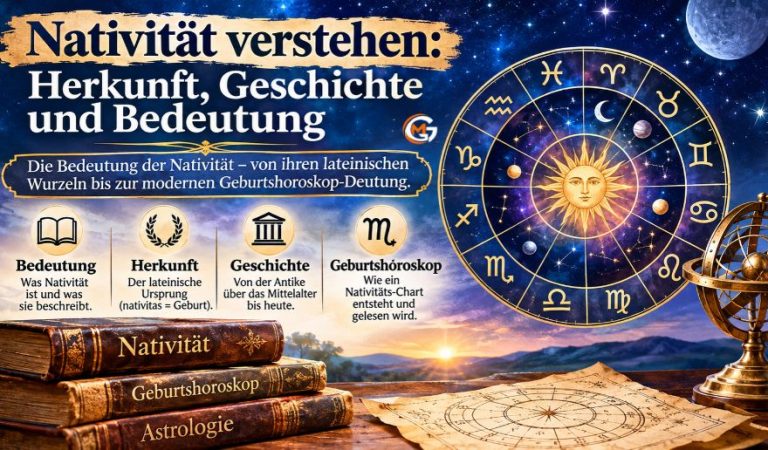
A German word can hold several layers of history. Nativität is one of them. It refers mainly to the positions of celestial bodies at a person’s birth, a concept closely connected with astrology and the traditional birth horoscope.
To understand Nativität, it helps to separate three things: the word’s Latin origin, the history of people recording the night sky, and the meanings astrologers assign to those records. The distinction matters because a calculated sky position is not the same as a prediction about a person’s life.
This guide explains the term in clear English, follows its development across cultures, and shows how a natal chart is made and read.
Quick info: Nativität at a Glance
| Detail | Information |
|---|---|
| Term | Nativität |
| Language | German |
| Word type | Feminine noun |
| Article | Die Nativität |
| Latin origin | Nativitas |
| Literal root meaning | Birth |
| Main modern context | Astrology |
| Core definition | Celestial positions at birth |
| Related German term | Geburtshoroskop |
| Older related term | Genitur |
| English comparison | Nativity; natal horoscope |
| Traditional subject | Individual birth chart |
| Typical chart inputs | Birth date, time, place |
| Scientific status | Interpretations are unproven |
What Does Nativität Mean?
In modern German, Nativität is primarily an astrological term for the arrangement of celestial bodies when someone is born. It may also refer to the birth horoscope based on that arrangement. A horoscope is a diagram or record of calculated positions, while a reading adds symbolic meanings to them. Keeping those steps separate makes the subject easier to understand. The plural is Nativitäten.
The term does not mean that a person’s character or future is actually determined by the sky. That idea belongs to astrological belief. Anyone trying to understand Nativität in an old book, a dictionary, or a modern chart should first check whether the passage discusses celestial positions, their interpretation, or birth itself.
The Latin Origin of Nativität
Nativität comes from the Latin nativitas, meaning birth. That word belongs to a family of terms related to being born, including nativus, meaning native or born. English nativity shares the same roots. Over time, the German word developed a specialized use connected with the moment of birth and its supposed astrological significance. That is why the term appears in writings about horoscopes.
The Earliest History of Birth Astrology
The ideas behind natal charts are much older than the modern German term. In ancient Mesopotamia, observers tracked the Moon, planets, and unusual sky events. These observations also belonged to divinatory traditions. People sometimes treated celestial events as signs about earthly affairs. These practices gradually created a setting in which an individual’s birth could be linked to a particular arrangement in the sky.
Some of the earliest surviving records of individual birth horoscopes date to 410 BCE in Babylonia. These clay-tablet texts did not look like today’s colorful circular charts. They generally noted dates and astronomical circumstances around a birth, with limited interpretation. They show the sky being recorded for individuals, not only kingdoms.
Greek, Medieval, and Renaissance Traditions
In the Hellenistic world, astrologers developed more elaborate ways to describe births. They combined the zodiac with rising signs, planetary relationships, and divisions of the sky that became known as houses. Greek writings organized these techniques into natal astrology. The astronomer and astrologer Ptolemy later described principles that readers studied for centuries.
Astrological texts continued to circulate through Arabic-speaking scholarly communities and medieval Europe. During the Renaissance, some physicians, court scholars, and advisers consulted horoscopes alongside other inherited ideas about nature. Their interest shows astrology’s historical reach, not the accuracy of its predictions. Modern astronomy eventually separated celestial calculations from claims about destiny.
How the Word Appears in German Texts
Readers may encounter die Nativität in older German writing about a birth, the position of the stars at birth, or a fate supposedly associated with that position. Related astrological vocabulary includes Genitur, Radixhoroskop, and Geburtshoroskop. Geburtshoroskop is the clearest modern term for a birth chart. The closely spelled word Natalität means birth rate in demographic statistics and should not be confused with Nativität. Likewise, Nativitätsstil names a medieval calendar convention in which the year began on December 25, not a kind of horoscope.
Nativität Versus the English Word Nativity
Mast Read: Severna Dakota: Discover Its History, Culture, and Natural Beauty
In English, nativity can mean someone’s birth or circumstances of birth, and older usage can also refer to a horoscope. For most modern US and UK readers, however, the Nativity usually refers to the birth of Jesus, particularly in Christmas stories, art, and church traditions. A nativity scene is not a natal chart. Both expressions share a linguistic origin, but their common modern meanings differ. Context is essential when translating a historical German passage into English.
How Is a Natal Chart Calculated?
A basic natal chart starts with three details: a person’s birth date, local clock time, and birthplace. Location and time affect the visible sky. A chart calculator converts the recorded time using the historical time zone and any daylight-saving rules, then determines celestial positions using astronomical data. It calculates planetary and horizon positions within a zodiac system.
The result is often a circular diagram divided into twelve sections. The calculations can describe where planets and the Moon were at a particular moment, but the meanings assigned to the diagram are not established by astronomy. If the birth time is unknown, some planetary positions can still be estimated for the date. The ascendant and house placements, however, may be unreliable or impossible to determine accurately.
Main Elements of a Birth Horoscope
Planets and Zodiac Signs
A traditional Western chart includes the Sun, Moon, and planets placed within twelve zodiac signs. Astrologers give each body and sign a symbolic role. For example, they often associate the Sun with identity and the Moon with emotional life. These are conventions within an interpretive tradition, not measured psychological facts. Different traditions also use different zodiac frameworks, which can produce different sign labels.
The Ascendant and Twelve Houses
The ascendant is the zodiac point rising on the eastern horizon at the chosen time and place. It helps organize the chart’s twelve houses, which astrologers associate with areas such as relationships, work, and home. Different house systems divide the chart differently. Two programs may therefore show different house boundaries.
Planetary Aspects
Aspects describe angular relationships between chart positions. Common examples include a conjunction, when two positions appear close together, and an opposition, when they are roughly 180 degrees apart. Astrologers use these angles to build interpretations about supposed tensions or connections. The angles are measurable, but their supposed personal meaning is not established.
A Simple Example of Reading a Chart
Imagine someone born in London on June 15, 1990, at 8:30 a.m. A chart program would first convert that local birth time correctly, identify London’s coordinates, and calculate the relevant celestial positions. It would then display the Sun and Moon in their calculated signs, mark the rising point, and arrange the houses. A specific rising sign cannot be claimed without those calculations.
An astrologer might then discuss how the Sun sign and Moon sign are traditionally interpreted together, before looking at the ascendant or aspects. A reader can follow the process without accepting its predictions. To compare programs, use identical birth details and settings.
Why People Explore Nativität Today
Some readers explore natal charts out of curiosity about cultural history. Others enjoy the symbolic language as a prompt for self-reflection or discussion. Modern websites can generate a chart in seconds, making a once specialized practice easier to encounter. Speed does not make interpretations scientifically tested. Birth charts are best treated as cultural material or personal entertainment rather than evidence about someone’s abilities, relationships, or prospects.
Common Errors, Limits, and Privacy Concerns
One frequent mistake is assuming that a Sun sign describes an entire natal chart. Another is entering a guessed birth time and treating the rising sign as certain. Historical time-zone changes, daylight-saving rules, and different chart settings can also explain conflicting results. Before comparing interpretations, check the underlying inputs. Check what was calculated and what was interpreted.
Scientific studies have not demonstrated that natal astrology reliably predicts personality or future events. A planet’s position is an astronomical observation; a claim about an individual’s fate is a separate assertion requiring evidence. Avoid basing medical, financial, legal, or relationship decisions on a horoscope. If using a website, consider whether it stores birth details, requires an account, or shares information with advertisers. Protect your birth details.
Final Thoughts
To understand Nativität is to understand both a word and a long-running cultural practice. Its roots lie in the Latin language, while its familiar German meaning points to the celestial arrangement at birth. Its history spans clay tablets and modern software. The calculations behind a chart can be precise, but its predictions are not scientifically validated. That distinction allows readers to appreciate the tradition without confusing it with established knowledge.
FAQs
What does Nativität mean in English?
Nativität generally refers to the positions of celestial bodies at a person’s birth, or the horoscope based on them. In English, natal chart or birth horoscope is usually clearer than nativity when discussing astrology.
Where does the word Nativität come from?
It comes from Latin nativitas, meaning birth. Related terms appear in several European languages, though their everyday meanings differ.
Is Nativität the same as a birth horoscope?
The terms are closely related. Nativität can name the celestial arrangement at birth, while a birth horoscope is a representation of those positions. In astrological writing, the words are often used with considerable overlap.
How old is natal astrology?
Individual birth horoscopes survive from ancient Babylonia as early as 410 BCE. Later Greek-speaking astrologers developed many familiar chart techniques. The broader practice of observing the sky for signs is older still.
What information is needed to create a natal chart?
Usually, you need the date, local time, and place of birth. A calculator uses these details to determine sky positions and horizon-based chart features. Accurate historical time-zone handling also matters.
Can I calculate a birth chart without a birth time?
Yes, but the result will be incomplete. Many planetary positions can be estimated from the birth date, while the ascendant and houses depend strongly on the time. Some calculators therefore omit these features.
Does Nativität mean the same thing as the Christian Nativity?
No. The terms share a Latin root connected with birth. The English phrase the Nativity normally concerns Jesus’ birth, whereas German Nativität is chiefly used in astrology. The surrounding text determines the intended meaning.
Is there scientific proof that natal charts predict personality?
No reliable scientific evidence shows that natal charts can predict someone’s personality or life events. Calculations and interpretations are different things. You can study the tradition without treating its predictions as facts.
For More News and Daily Updates Visit: Gigly Magazine
