

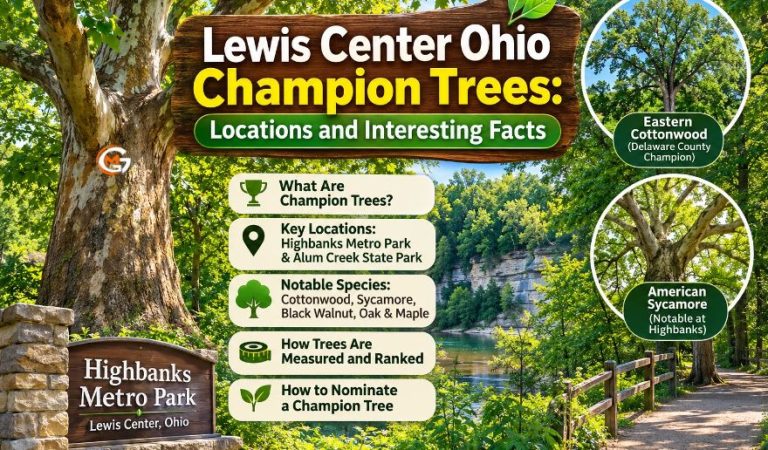
Lewis Center, Ohio, is surrounded by wooded parks, river valleys, and trees that can make even experienced hikers stop and look up. Some have unusually broad trunks. Others rise above the forest canopy or have been growing for generations.
People exploring Lewis Center Ohio Champion Trees often want to know which trees have earned official recognition and where they can see them. The important distinction is that an impressive tree is not necessarily a registered champion.
Ohio maintains records of exceptionally large trees, including several in Delaware County. This guide explains those records, highlights worthwhile places to visit, and shows how ordinary visitors can recognize and help protect remarkable trees.
Quick info: Lewis Center’s Champion Trees at a Glance
| Detail | Information |
|---|---|
| Community | Lewis Center, Ohio |
| County | Delaware County |
| Region | Central Ohio, United States |
| Main local attraction | Highbanks Metro Park |
| Highbanks address | 9466 Columbus Pike |
| Nearby state park | Alum Creek State Park |
| Notable county champion | Eastern cottonwood |
| Another county champion | Black walnut |
| State recognition | Ohio Big Tree Program |
| Main measurement | Trunk circumference |
| Other measurements | Height and crown spread |
| Champion comparison | Trees of the same species |
| Historic local claim | Highbanks national sycamore |
| Visiting reminder | Check public access first |
What Is a Champion Tree in Ohio?
A champion tree is the largest known, verified example of a particular species within a defined area. Ohio’s Big Tree Program measures both native and non-native trees and ranks them using a standard point system. A state champion leads its species in Ohio, while a national champion competes against known specimens across the United States. This is not a contest between unrelated species: a modest-sized pawpaw may be a champion even though a nearby cottonwood towers over it. Recognition is based on measured size, not age, beauty, historical importance, or the number of people who visit the tree.
Which Champion Trees Are Documented in Delaware County?
Ohio’s published native champion list identifies an eastern cottonwood in Delaware County with a trunk circumference of 380 inches, a height of 122 feet, and an average crown spread of about 103 feet. Its listed score is 527 points. The same list records a Delaware County black walnut measuring 211 inches around and 103 feet tall, with a score of approximately 340 points. These are county-level locations within the state register, not proof that either tree stands inside Lewis Center itself. Exact addresses and access arrangements need separate confirmation before a visit.
ohiodnr.gov
The Famous Eastern Cottonwood Near Alum Creek
An older account describes a huge eastern cottonwood near Cheshire Road and Africa Road, in the Alum Creek State Park area. The tree was recognized as an Ohio champion and drew attention for its massive trunk and spreading branches. That account reported measurements different from those in Ohio’s more recent register, so readers should not assume the historical description and today’s listed specimen are definitely the same tree. Cottonwoods thrive in moist, open areas near streams and reservoirs. Their deeply ridged bark, fast growth, and broad crowns make mature trees especially striking. The county’s current state-champion listing is verified; a precise present-day viewing spot is not established here.
Highbanks Metro Park and Its Historic Sycamore
Highbanks Metro Park is a reliable place to appreciate large native trees in Lewis Center. Its main entrance is at 9466 Columbus Pike, and the park covers roughly 1,204 acres. Wooded ravines, floodplain habitat, and steep shale bluffs along the Olentangy River support an impressive variety of mature trees. In 2022, part of its forest was recognized by the Old-Growth Forest Network.
A historical Metro Parks planning document called Highbanks home to a national champion American sycamore. However, Ohio’s more recent national champion listing places the American sycamore record in Ashland County. The older Highbanks reference is an interesting part of local tree history, not confirmation that its sycamore holds the national title today. Visitors can enjoy enormous-looking sycamores without assigning a record to an unidentified tree.
Metro Parks – Central Ohio Park System+2
Best Places to See Large Trees Around Lewis Center
Highbanks offers several useful routes for a tree-focused walk. The 0.9-mile Sycamore Trail passes sycamore, buckeye, and cottonwood trees beside the Olentangy River. The 2.3-mile Overlook Trail passes through a protected natural area and reaches a river overlook, while the 2.5-mile Dripping Rock Trail winds through forest and steep ravines. Overlook and Dripping Rock are more demanding than the shorter Sycamore route. Alum Creek State Park offers another setting with wooded paths and waterfront scenery. Neither park should be treated as a guaranteed route to a specific registered champion unless park staff confirm its location.
Central Ohio Park System+1
Tree Species Worth Learning to Recognize
Mast Read: Sérya: How This Unique Name Is Used in Modern Branding
American sycamores have mottled bark that often peels to reveal pale patches, making their trunks easy to spot. Eastern cottonwoods commonly grow beside water and develop thick, deeply furrowed bark. Black walnuts have compound leaves and round fruits enclosed in green husks. Oaks support an extraordinary range of insects and wildlife, while maples add vivid fall color. Hickories can be identified partly by their nuts, leaves, and distinctive bark. Learning these differences makes a woodland walk more rewarding, even when no tree has an official title. A remarkable specimen may be hidden among entirely ordinary-looking neighbors.
How Ohio Measures and Scores Champion Trees
Three measurements determine an Ohio tree’s score: trunk circumference in inches, total height in feet, and average crown spread in feet. Circumference is normally taken 4.5 feet above the ground. To calculate the score, add circumference and height to one-quarter of the average crown spread. For example, a tree measuring 200 inches around, 100 feet high, and 80 feet across would earn 320 points. Foresters also account for slopes, unusual trunks, and competing stems. Estimates can help identify candidates, but official verification requires careful identification and measurements. The highest score for a species can change as new trees are nominated or older champions decline.
ohiodnr.gov
State Champions, National Champions, and Changing Records
A tree’s title is a snapshot of known measurements, not a permanent guarantee. A larger specimen may be discovered, a tree may lose major limbs, or fresh measurements may correct an old record. National and state lists are also maintained separately, so older articles and signs can disagree with newer registers. That explains why a historical claim about Highbanks cannot replace a current listing. Even an officially designated champion receives no automatic legal protection from Ohio’s Big Tree Program. Ownership rules, park regulations, and conservation measures still determine what can happen around it.
How to Verify a Tree Before Planning a Visit
Begin with the Ohio Department of Natural Resources champion listings and check the species, county, measurements, and available record date. County names are not street addresses; Delaware County includes many communities beyond Lewis Center. If a tree is associated with a park, ask its staff whether the specimen is accessible and whether its location can be shared. Some celebrated trees stand on private land, and precise locations may be withheld to prevent damage. Historical photographs can help identify a tree, but they do not establish its condition or accessibility today.
Visiting Large Trees Without Damaging Them
Seeing an old tree up close is memorable, but the surrounding soil and roots need protection. Stay on permitted trails, avoid climbing fragile branches, and do not remove bark, seeds, or living material. Never enter private property without permission. For a comfortable outing, remember: • wear shoes suited to uneven ground; • check trail conditions and posted rules; • photograph large trees from a safe distance. Falling limbs are a risk during high winds or storms, especially beneath heavy mature crowns. Families can get excellent views without stepping off trails or approaching unstable trunks.
How to Nominate a Tree and Why It Matters
Anyone who notices an exceptional tree can investigate whether it might qualify for Ohio’s Big Tree Program. First identify the species correctly and obtain permission to measure a privately owned tree. Record its circumference, estimate its height and crown spread, take clear photographs, and compare the score with the published state champion. Ohio accepts nominations for promising candidates and arranges professional checks. These efforts do more than celebrate records: mature trees provide shade, store carbon, support birds and insects, and preserve links to earlier landscapes. Protecting their habitat is often as important as recognizing their size.
Final Thoughts
The story of Lewis Center Ohio Champion Trees combines verified county records with the enjoyment of local forests. Delaware County has documented state champions, including an eastern cottonwood and black walnut, while Highbanks offers an accessible place to encounter remarkable mature trees. Historical champion claims should be checked against newer records before they are repeated as current facts. Whether you visit a well-known specimen or simply explore a wooded trail, careful observation and respect for these living landmarks make the experience worthwhile.
FAQs
Are there official champion trees in Lewis Center, Ohio?
Ohio records champion trees in Delaware County, which includes Lewis Center, but a county listing alone does not confirm a tree’s precise location within the community. Highbanks has large trees and a notable historical sycamore claim.
Where can I see large trees in Lewis Center?
Highbanks Metro Park is the clearest starting point. Its Sycamore Trail passes tall river-valley trees, while other routes explore mature woodland. Check trail conditions before visiting, and do not assume a registered champion is marked.
Is the Alum Creek cottonwood still a champion tree?
Ohio’s published state register lists an eastern cottonwood in Delaware County. An older account places a famous cottonwood near Alum Creek, but the information reviewed does not conclusively connect that individual tree to the current listing.
Does Highbanks have a national champion sycamore today?
An older park planning document describes a national champion sycamore at Highbanks. A more recent Ohio national-champion list names an American sycamore in Ashland County, so the historic Highbanks claim should not be presented as current.
What makes a tree a state champion?
A tree must be identified and measured against others of its species in Ohio. Its circumference, height, and average crown spread contribute to its score. State forestry officials verify promising nominees before recognition.
What is the best trail for spotting sycamores?
Highbanks’ 0.9-mile Sycamore Trail is a practical choice because it follows riverside habitat with sycamore, buckeye, and cottonwood. It is shorter and easier than some of the park’s ravine routes.
Can I visit a champion tree on private land?
Only with the landowner’s permission. Champion recognition does not create a public right of access. If a location is not disclosed, respect that decision and explore public park trails instead.
How do I nominate a large tree in Ohio?
Identify the species, measure the trunk, height, and crown, and compare the score with Ohio’s published champions. Submit the required details through the state’s nomination process, allowing a forester to verify the candidate.
For More News and Daily Updates Visit: Gigly Magazine
