

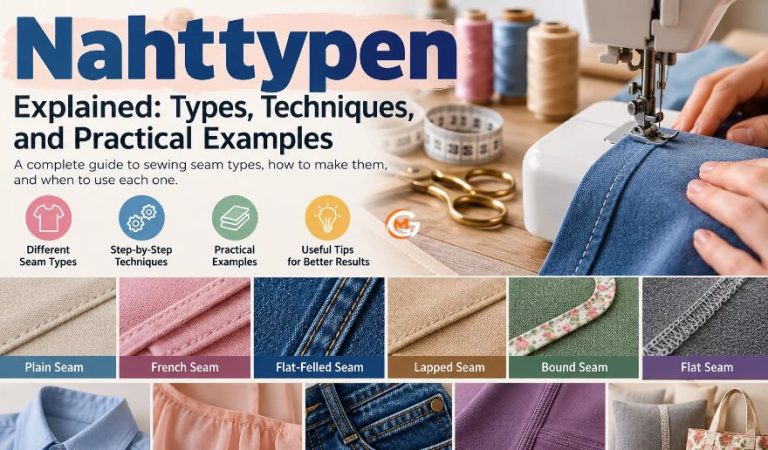
A well-made seam does more than hold two pieces of fabric together. It helps clothing keep its shape, feel comfortable, and withstand regular use. The German word Nahttypen means “seam types,” and it covers several ways of joining or finishing fabric in sewing.
Different seams solve different problems. A shirt needs a smooth, reliable join, while jeans need strong construction that handles frequent movement. Delicate fabric may need hidden raw edges, and stretch fabric needs stitching that gives without breaking.
This guide explains common seam types, how to make them, and where they work best. It also covers useful tools, fabric choices, mistakes to avoid, and simple ways to improve your results at home.
Quick Bio: Nahttypen at a Glance
| Detail | Information |
|---|---|
| German term | Nahttypen |
| English meaning | Seam types |
| Main subject | Sewing and textile construction |
| Primary purpose | Join or finish fabric |
| Basic seam | Plain seam |
| Enclosed option | French seam |
| Reinforced option | Flat-felled seam |
| Overlapping construction | Lapped seam |
| Bound construction | Binding covers an edge |
| Low-bulk construction | Flat seam |
| Common stitch | Straight stitch |
| Stretch-friendly stitches | Zigzag or stretch stitch |
| Edge finishes | Zigzag, overcast, serging |
| Key selection factors | Fabric, stress, appearance |
What Does Nahttypen Mean in Sewing?
Nahttypen refers to different seam constructions used to assemble or finish fabric. A seam is the joined area where fabric pieces meet; a stitch is the repeated path made by thread. That distinction matters because one seam can use different stitches. Technical textile classifications consider how material overlaps, folds, or meets. Common categories include superimposed, lapped, bound, and flat seams. Others cover decorative stitching, edge finishing, attaching components, and single-layer construction. Home sewers usually encounter simpler everyday names.
How Seam Construction Affects Strength and Appearance
A seam’s performance depends on fabric weight, thread, allowance, needle choice, and the strain placed on it. The seam allowance is the space between a cut edge and stitching line. Many home patterns specify 5/8 inch (about 1.6 cm), while others use 3/8 inch (about 1 cm). Follow the pattern’s stated width. Pressing helps fabric lie flat, and suitable edge finishing prevents many woven materials from unraveling. Strong stitching alone cannot save a seam that is poorly matched to its fabric.
Main Types of Nahttypen and Their Uses
Plain and French Seams
A plain seam joins fabric pieces, usually right sides together, with a straight stitching line. It is quick and useful for shirts, skirts, cushions, and bags, although raw edges may need finishing. A French seam encloses the edges inside a second stitched join. It creates a tidy interior in sheer blouses, light dresses, and unlined clothes without bulky overlocking. The additional folding takes time and is less convenient on tight curves or thick materials.
Flat-Felled, Lapped, Bound, and Flat Seams
A flat-felled seam folds seam allowances inward and secures them flat with another stitching row. It appears in jeans and work shirts. A lapped seam joins overlapping pieces; the exact construction varies. Bound seams use a fabric strip or tape to enclose an exposed edge, often inside jackets. A flat seam meets fabric edges with minimal overlap, reducing bulk in some underwear and sportswear. A flat seam and a flat-felled seam are not interchangeable: their structure and use differ.
Stitches and Seam Finishes: What Is the Difference?
A straight stitch works well on stable woven fabric but may break under substantial stretching. A narrow zigzag or a machine’s stretch stitch allows more movement in jersey and other knits. Edge finishing is a separate step. Zigzagging or overcasting raw allowances helps prevent fraying. A serger, called an overlocker in the UK, can trim and wrap edges quickly. Topstitching can secure folded fabric or add visible detail. These techniques do not automatically turn a plain seam into a French or flat-felled seam.
Mast Read: Suzanne Chase: What to Know About Chevy Chase’s Family Life
Essential Tools and Preparation Before Sewing
A regular sewing machine handles most beginner seams. Keep scissors, pins or clips, a ruler, matching thread, a seam ripper, and an iron nearby. Select needles for the material: universal or sharp needles for appropriate wovens, ballpoint or stretch needles for many knits. Prewash when care instructions allow, since shrinkage can distort finished seams. Mark the allowance and test stitches on scraps. Look for uneven feeding, tight thread, or puckering before sewing the garment.
How to Sew Plain and French Seams
Making a Plain Seam
Place pieces right sides together, matching edges and pattern marks. Pin or clip without stretching. Use an appropriate straight stitch and sew steadily along the marked allowance. Backstitch briefly at both ends unless the pattern specifies another method. Remove pins before they reach the needle. Press the stitching first, then press allowances open or to one side as directed. Finish exposed woven edges with zigzagging, overcasting, or another suitable technique. Consistent feeding and pressing matter more than speed.
Making a French Seam
For a 5/8-inch (1.6-cm) total allowance, start with the wrong sides together. Sew 3/8 inch (about 1 cm) from the edge. Trim the allowance to roughly 1/8 inch (3 mm), avoiding the stitches. Press, fold so the right sides face, and stitch again 1/4 inch (about 6 mm) from the fold. The second line encloses the raw edge at the intended final seam position. Press toward one side and check for exposed threads. Use different measurements if the pattern requires them.
How to Make a Durable Flat-Felled Seam
Join pieces right sides together, following the pattern’s allowance. Press both allowances to one side and trim the lower one narrower. Fold the wider allowance over the trimmed edge, tuck its raw edge underneath, and press the strip flat. Stitch close to the folded edge. You now have enclosed edges and two stitching lines. Practice on denim scraps first: folded layers can challenge lightweight machines, particularly at thick crossings. Make sure the fabric feeds smoothly rather than forcing it through.
Choosing the Best Seam for Each Fabric and Project
Woven Fabrics and Everyday Garments
Check fabric thickness, fraying, and how much strain the seam will carry. Plain seams with clean finishes suit cotton shirts, skirts, and household textiles. A narrow French seam hides raw edges on chiffon, voile, and other lightweight wovens. Flat-felled seams suit sturdy workwear where durability matters. Heavy coating or upholstery fabric can form hard ridges when repeatedly folded. Test the finished construction on scraps, including lining or interfacing where relevant, before cutting important pieces.
Knit Fabrics, Activewear, and Comfort
Knit fabrics stretch through their looped structure, so seams need flexibility. Use a narrow zigzag, stretch stitch, or suitable overlock construction where clothing must expand. A ballpoint or stretch needle helps avoid damage and skipped stitches. Low-bulk seams can improve comfort in close-fitting clothes, although specialized machinery may be necessary. Stretch a sewn sample gently in the direction of normal movement. If thread snaps, change the stitch or construction before continuing. Test both stretch and recovery.
Benefits, Limitations, and Practical Alternatives
No seam suits every situation. Plain seams are quick to alter but their exposed edges may fray. French seams look clean inside yet require extra stitching and enough allowance. Flat-felled seams are durable but can become thick. Binding adds a tidy finish along with extra material. Without a serger, try a machine zigzag or overcast stitch. Hand stitching is useful for repairs in difficult places. Fabric adhesive can help with some low-stress crafts but should not replace stitching in joints that bear repeated strain.
Common Seam Problems and How to Fix Them
Puckering, Crooked Lines, and Uneven Feeding
Puckering can result from unsuitable tension, stitch length, needles, or feeding. Replace a dull needle and check machine threading before changing settings. Test on scraps with the same layers. If one layer creeps forward, pin more closely or try a walking foot. Do not pull fabric through; let the feed dogs move it. For crooked seams, follow a marked line or needle-plate guide and slow down at curves. Pressing may reduce mild ripples, but it cannot fix every distorted join.
Fraying, Broken Stitches, and Bulky Joins
Fraying usually needs an edge finish, not another straight stitching row. Choose zigzagging, binding, or overcasting according to fabric and appearance. Broken stitches on knits often mean the seam lacks stretch; test a suitable stitch instead. If a join feels bulky, grade or trim enclosed allowances where the construction allows, then press carefully. Do not cut so close that the join loses support. Inspect the finished project after washing, since use can reveal weak areas missed during sewing.
Final Thoughts
Understanding Nahttypen helps you match each construction to its purpose. Begin with plain seams, try French seams on lightweight fabric, and practice flat-felled seams when durability matters. Accurate allowances, suitable stitches, and careful pressing improve nearly every project. Testing scrap fabric first is often easier than repairing a finished garment.
(FAQs)
What does Nahttypen mean in sewing?
Nahttypen is German for “seam types.” It describes ways fabric is joined or finished, including plain, French, and flat-felled seams. Choose among them based on fabric properties, construction needs, and the finished appearance.
What is the difference between a seam type and a stitch type?
A seam type describes how fabric pieces are arranged and joined. A stitch type describes how thread forms that connection. For example, a plain seam may be sewn with a straight, zigzag, or another suitable stitch.
Which Nahttypen are easiest for beginners?
Plain seams are easiest because they need one main stitching line. Practice keeping an even allowance and pressing afterward. Then try French seams on lightweight cotton to learn how enclosed edges are made.
Which seam is strongest for jeans and workwear?
Flat-felled seams are a durable choice because folded allowances are secured with extra stitching. Actual strength also depends on fabric, thread, and workmanship. Thick intersections require a machine capable of feeding several layers.
Which seam works best for delicate or sheer fabrics?
French seams suit light woven fabrics such as chiffon and voile. They hide raw edges even in unlined garments. Keep the seam narrow and test first, especially around tight curves or gathered areas.
What should I use for stretchy fabrics?
Use a stretch-friendly seam and stitch. Narrow zigzag, machine stretch stitches, and suitable overlock seams are common choices. Select a knit needle and gently stretch a sample to check whether its stitches hold.
Can I sew different seam types without a serger?
Yes. Regular machines can sew plain, French, and flat-felled seams and finish edges with zigzag or overcast stitches. Sergers make some jobs faster, but they are optional for learning these methods.
How do I stop seam edges from fraying?
Try zigzagging, overcasting, binding, or an enclosed construction such as a French seam. Match the finish to fabric weight and weave. Check exposed edges before laundering or wearing the finished garment.
For More News and Daily Updates Visit: Gigly Magazine
