

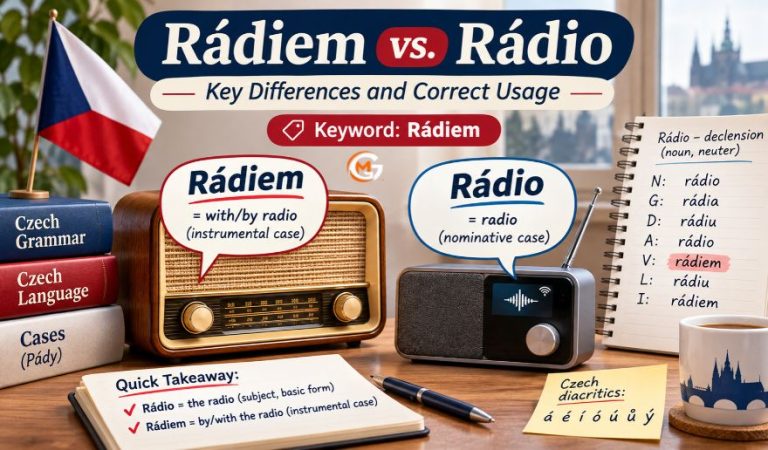
The Czech words rádiem and rádio look similar, but they serve different grammatical purposes. Both relate to radio communication or radio equipment. Understanding their difference is important for anyone learning Czech or translating Czech sentences into English.
In everyday Czech, rádio is the basic noun meaning “radio.” The form rádiem is used in specific grammatical situations, especially when describing communication through radio or using a radio as an instrument.
For English speakers, the distinction can seem unusual because English rarely changes noun endings this way. This guide explains the meanings, grammar rules, pronunciation, common mistakes, and practical examples that make both forms easier to understand.
Quick info: Rádiem and Rádio at a Glance
| Detail | Information |
|---|---|
| Language | Czech |
| Main word | Rádio |
| Related form | Rádiem |
| Word category | Noun |
| Grammatical gender | Neuter |
| Basic English meaning | Radio |
| Rádiem translation | By radio, with a radio |
| Dictionary form | Rádio |
| Nominative singular | Rádio |
| Accusative singular | Rádio |
| Instrumental singular | Rádiem |
| Genitive singular | Rádia |
| Locative singular | Rádiu |
| Instrumental plural | Rádii |
| Main difference | Grammatical case |
What Does Rádiem Mean in English?
Rádiem usually translates as “by radio,” “via radio,” or “with a radio,” depending on the sentence. It is not the name of a separate kind of radio. It is a changed form of the Czech noun rádio. For example, Spojili jsme se rádiem means “We communicated by radio.” Here, the ending tells readers how the communication happened. In another context, s rádiem means “with a radio,” rather than “by radio.” A direct, word-for-word translation is therefore not always enough.
Rádiem vs. Rádio: The Essential Difference
Rádio is the form listed in a Czech dictionary. It can refer to a physical receiver, the medium of radio broadcasting, or sometimes a radio station. Rádiem is the instrumental singular form used when grammar requires it. Compare Zapnul jsem rádio (“I turned on the radio”) with Udržovali jsme spojení rádiem (“We kept in contact by radio”). The object or medium is related, but its job in the sentence changes. Neither spelling is universally more correct; the sentence determines which one you need.
Why Does Czech Change the Ending?
Czech uses a system of grammatical cases. These cases show what a noun is doing, such as acting as the subject, receiving an action, or describing a means of doing something. English usually conveys those relationships through word order and prepositions. Czech often uses endings as well. Rádio is a neuter noun, and its forms change according to case and number. This process is called declension. Understanding the role of the noun is more useful than memorizing two spellings without context.
The Instrumental Case Explained
The instrumental is the seventh Czech case. It often answers the question čím?, meaning “with what?” or “by what means?” When radio is the means of transmitting a message, rádiem fits naturally. The same case also appears after certain prepositions, including s when it means “with.” Instrumental does not always translate to a single English preposition, so interpret the complete phrase first.
When Is Rádio the Correct Choice?
Use rádio when the noun is the subject of a sentence or a direct object in the singular. Rádio hraje means “The radio is playing,” while Poslouchám rádio means “I’m listening to the radio.” In Koupili jsme nové rádio (“We bought a new radio”), it remains rádio because the device is the direct object. The same visible form covers the nominative and accusative cases. That is why you cannot automatically change rádio to rádiem whenever an action involves a radio.
When Should You Use Rádiem?
To Describe Communication by Radio
Use rádiem when the sentence identifies radio as the channel or means of communication. Poslali zprávu rádiem means “They sent a message by radio.” This pattern can appear in discussions of broadcasting, emergency communication, and wireless contact. It describes the method, not necessarily a handheld receiver. In everyday speech, a different expression may sometimes sound more natural, depending on what is being communicated and whether someone means a broadcast, a call, or a radio device.
With the Preposition S
The phrase s rádiem means “with a radio.” For example, Pracoval s rádiem can mean “He worked with a radio,” with the exact activity supplied by context. The preposition s takes the instrumental case when expressing accompaniment or working with something. This is different from saying you heard an announcement on the radio. In that situation, Czech normally uses v rádiu, not s rádiem.
How Prepositions Affect the Word Rádio
Mast Read: Coerant: Understanding Its Meaning and Business Identity
Prepositions provide helpful clues because many require a particular case. V rádiu is a familiar way to say “on the radio,” especially for news, music, or an interview. Do rádia can mean “into the radio” or “to radio broadcasting,” depending on the action. Z rádia means “from the radio,” while bez rádia means “without a radio.” Notice how the endings respond to the phrase rather than to the English word “radio.” Three useful patterns are:
-
v rádiu — on the radio
-
do rádia — into or onto radio broadcasting
-
s rádiem — with a radio
The Other Forms of Rádio You May See
Learners will also encounter rádia, rádiu, and several plural forms. The singular genitive is rádia, as in bez rádia (“without a radio”). The singular dative and locative use rádiu, as in k rádiu (“toward the radio”) and v rádiu (“on the radio”). The nominative and accusative plural are rádia, as in Dvě rádia (“Two radios”). Other plural forms include rádií, rádiím, rádiích, and rádii. Importantly, rádii is instrumental plural, while rádiem is singular. These are standard grammatical forms, not alternative names for broadcasting technology.
Everyday Examples That Make the Rule Clear
A useful comparison is Slyšel jsem to v rádiu (“I heard it on the radio”) versus Předali zprávu rádiem (“They passed the message by radio”). The first describes where information was heard; the second describes the channel used to send it. Another contrast is Opravuji rádio (“I’m repairing the radio”) and Zabývám se rádiem (“I deal with radio”). In the second example, the verb phrase zabývat se requires the instrumental. Pay attention to the whole verb phrase, not merely the nearest English translation.
How to Pronounce Rádio and Rádiem
In both words, the accent over á marks a long vowel. It does not mark the stressed syllable in the English sense; Czech typically stresses the first syllable. Rádio sounds roughly like “RAA-diyo,” with a short final o. Rádiem sounds roughly like “RAA-diyem,” ending in -em. These English-style guides are approximations, not exact sound matches. The difference is audible at the end, while the long á remains in both. Saying each word slowly can help connect the ending to its grammatical function.
Common Mistakes and How to Avoid Them
Mixing Up Radio as an Object and a Method
Poslouchám rádiem does not normally mean “I listen to the radio.” The correct expression is Poslouchám rádio, because the radio is what you listen to. Likewise, V rádiem is incorrect for “on the radio”; write v rádiu. If you mean a message sent by radio, however, rádiem may be the correct form. Ask whether the sentence describes a device, a broadcast location, or a means of sending information.
Assuming One English Phrase Always Fits
It is tempting to attach “by” to every instrumental form, but that can produce misleading translations. S rádiem commonly needs “with a radio,” and other instrumental constructions depend on the verb. Remember these quick checks: identify the verb, look for a preposition, and decide what role the radio plays. A Czech sentence can be grammatically correct while a mechanical English translation still sounds awkward. Meaning comes from the full sentence.
Related Words and a Spelling Mix-Up
Rozhlas often refers to radio broadcasting, while rádio can name both the medium and a receiver. Rádiový is an adjective meaning “radio-related,” as in rádiový signál (“radio signal”). Do not confuse rádiem with radiem, which lacks the accent. In Czech, radiem can be the instrumental of radium, the chemical element, and is therefore a different word. There is another technical overlap: rádiem can also be the instrumental of rádius, meaning radius. Usually the subject of the sentence makes the intended meaning clear.
Final Thoughts
The difference between rádio and rádiem is mainly grammatical, not technological. Rádio is the dictionary form and appears when the word serves as a singular subject or direct object. Rádiem is its instrumental singular form, often describing communication by radio or appearing after s. Other contexts require forms such as rádia or rádiu. Once you pay attention to verbs, prepositions, and the noun’s role, Czech radio-related expressions become easier to read, translate, and use correctly.
FAQs
What Does Rádiem Mean in English?
It often means “by radio,” “via radio,” or “with a radio.” The best translation depends on the surrounding verb and any preposition. For example, spojení rádiem refers to communication by radio, while s rádiem means “with a radio.”
Is Rádiem a Different Word From Rádio?
In ordinary radio-related Czech, no. It is the instrumental singular form of the noun rádio. The ending changes because the word has a different grammatical function. Context matters, since the same written form can also occur with the noun rádius.
When Do Czech Speakers Use Rádiem?
They use it when radio is the means of an action, particularly communication or signal transmission, and in expressions that require the instrumental case. It also follows s when that preposition means “with.”
Why Is Rádio Sometimes Written Rádiu?
Rádiu is another singular form, used in the dative and locative cases. You see it in expressions such as v rádiu (“on the radio”) and k rádiu (“toward the radio”). These are grammatical changes, not spelling errors.
Is V Rádiem or V Rádiu Correct?
Use v rádiu for something heard or broadcast on the radio. The preposition v takes the locative here. V rádiem combines the wrong case with the preposition and is not standard Czech.
How Do You Pronounce Rádiem?
A rough English guide is “RAA-diyem.” Keep the first vowel long and pronounce the final -em. Czech usually places stress on the first syllable, but the accent on á indicates vowel length rather than stress.
What Is the Plural of Rádio?
The nominative plural is rádia, as in “two radios.” The instrumental plural is rádii, not rádiem. Other plural endings appear in different cases, so choose the form based on the sentence rather than the number alone.
Is Rádiem Related to the Chemical Element Radium?
Not in the usual radio-broadcasting sense. Czech rádiem can mean “by radio,” while radiem, without the accent, is a form of radium, the chemical element. Their similar appearance makes accurate spelling and context important.
For More News and Daily Updates Visit: Gigly Magazine
